
Quick Answer: Short version: the random orbital sander wins for most people — it’s the one that leaves a tabletop glass-smooth, where the sheet sander can tattoo faint scratches into it. But the sheet sander has a few genuine advantages nobody talks about, and for certain jobs it’s actually the better tool. Pick wrong and you’ll either sand twice as slow — or sand everything twice.
You spend a whole weekend sanding a tabletop until it feels like glass. Then the stain goes on — and every faint scratch lights up like a spotlight. That is the moment most people discover they bought the wrong sander, and the store will not take back a weekend.
The good news is the choice takes about two minutes once you know the four real differences: finish, speed, corners, and the sneaky one — what the sandpaper costs you over two years. By the end of this guide you will know which sander earns its keep for your jobs, and which one is quietly eating your budget.
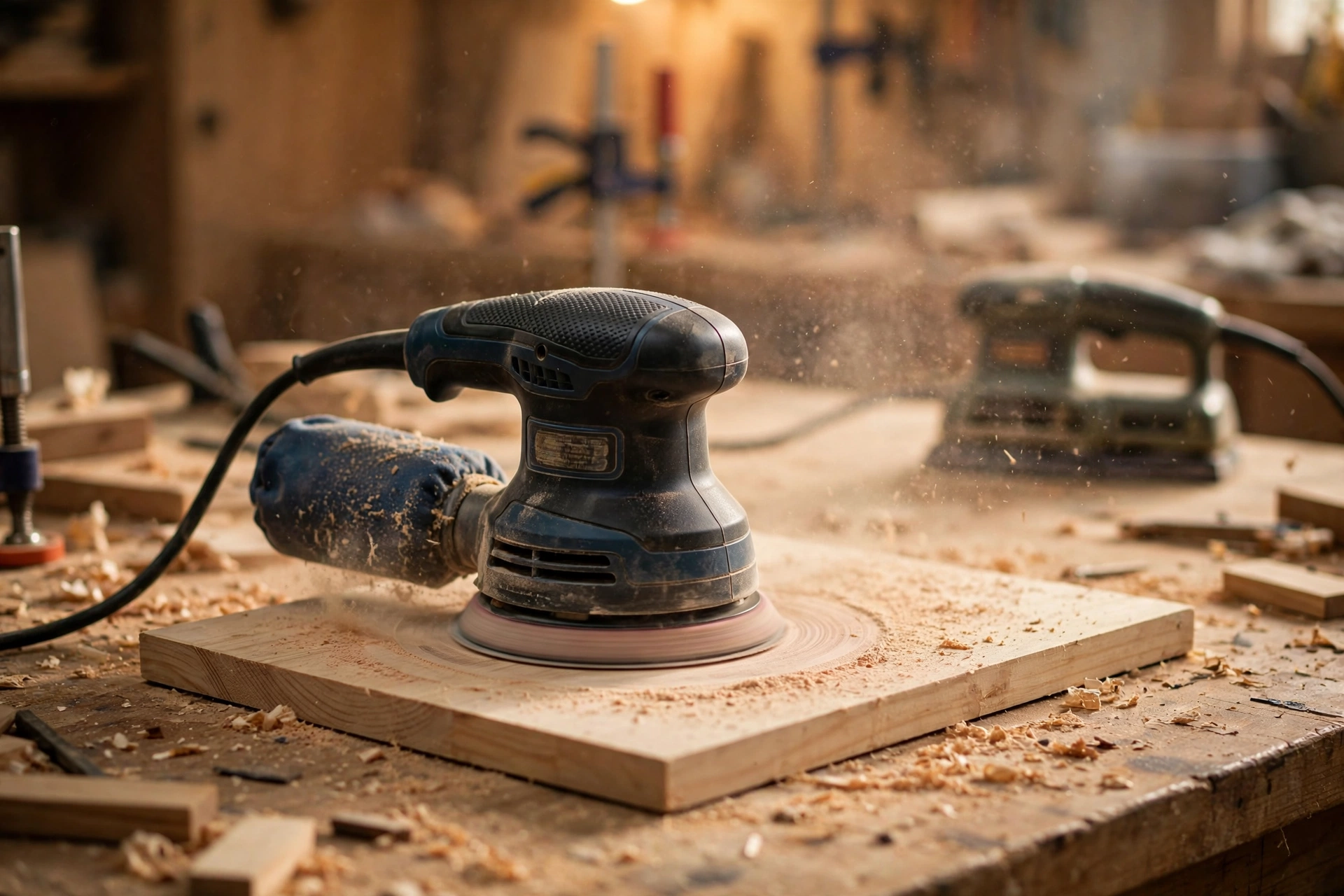
Safety first: Sanders create fine wood dust that is genuinely harmful to breathe — especially from MDF, pressure-treated lumber, and exotic hardwoods. Always wear a dust mask (N95 or better), work in ventilated space, and connect dust collection when you can. Dust in your eyes is no joke either — wear safety glasses.
Quick answer: what each sander does best
A random orbital sander (often just called an “orbital sander”) spins its round pad in tiny overlapping orbits while simultaneously rotating. That dual motion is the whole trick — it prevents the pad from traveling in one repeating path, which is what causes visible scratch patterns.
A sheet sander (also called a finishing sander or palm sander) moves its square or rectangular pad in tiny straight-line orbits — back and forth, no rotation. It uses quarter-sheets of standard sandpaper, clamped on.
Buy the random orbital sander if: you want one sander that handles 90% of jobs — stock removal, smoothing, and finishing — with the least visible scratching.
Buy the sheet sander if: you do a lot of finish sanding on flat surfaces, hate buying expensive hook-and-loop discs, or want to sand into square corners.
Buy both if: you refinish furniture regularly. They’re cheap enough that owning both is completely reasonable — more on that below.
How they actually work (and why it matters)
Random orbital sander
The pad (usually 5-inch diameter) moves in small orbits — typically 1/8″ to 3/16″ orbit diameter — while also spinning freely. Because the rotation is “random” (driven by the orbit, not geared), no single abrasive particle follows the same path twice. The result: scratches go in every direction at a microscopic level, which your eye reads as a uniform surface instead of visible lines.
This is why random orbitals are the go-to for finish work. The scratch pattern they leave is the least visible of any powered sander short of a wide-belt machine.
Sheet sander
The pad moves in a tight orbital pattern — usually 1/16″ orbits, much smaller than a random orbital’s — in straight lines only. No rotation. Because the motion is consistent, it can leave faint directional marks if you’re careless, which is why sheet sanders have a reputation (slightly unfair, mostly earned) for being slower and fussier about technique.
The big practical difference: the pad is a flat rectangle that takes quarter sheets of standard 9″×11″ sandpaper, held by clamps. No hook-and-loop discs. No proprietary anything.
Head-to-head: the differences that actually matter
| Random orbital sander | Sheet sander | |
|---|---|---|
| Pad shape | 5″ round (some 6″) | Square/rectangular (~1/4 sheet) |
| Motion | Orbit + random rotation | Straight-line orbit only |
| Finish quality | Excellent — least visible scratches | Good — can show faint lines if rushed |
| Stock removal speed | Fast (with coarse grit) | Slow to moderate |
| Sandpaper | Hook-and-loop discs ($0.50–$1+ each) | Quarter-sheet standard paper (~$0.15–$0.30 each) |
| Corners | Can’t reach square corners (round pad) | Reaches into corners (square pad) |
| Typical price | $50–$120 | $30–$70 |
| Dust collection | Usually good (holes + bag or vacuum port) | Basic (often just a dust bag) |
| Best for | All-around sanding, finishing | Finish sanding, detail work, tight budgets |
Finish quality: where the orbital earns its reputation
Here’s the thing nobody disputes: a random orbital sander leaves a better finish with less skill required. The random scratch pattern is forgiving — you can be a little sloppy with your technique and still get a surface that looks great under finish.
A sheet sander can produce an excellent finish, but it demands better technique: keep it flat, keep it moving, don’t press down, work through the grits. Rush it or tilt it, and you’ll see faint cross-grain scratches or the dreaded swirl-adjacent haze when the finish goes on. (If you’ve ever wondered why sanders leave swirl marks, technique is usually the answer, and sheet sanders punish bad technique more.)
Winner for finish quality: random orbital sander, and it’s not close for beginners.
Speed: the orbital removes material dramatically faster
Put 80-grit on both and attack a rough board. The random orbital will flatten it in a fraction of the time. The larger orbit, the rotation, and the more aggressive cutting action mean a random orbital can actually do light stock removal — taking down mill marks, leveling glue-ups, smoothing rough-sawn lumber.
A sheet sander with 80-grit feels like it’s politely asking the wood to become smoother. It’ll get there, but you’ll be there a while. Sheet sanders are finish sanders by design; asking one to remove serious material is like using a paring knife to butcher a side of beef. Technically possible. Deeply unpleasant.
Winner for speed: random orbital sander, by a wide margin.
Sandpaper cost: the sheet sander’s secret weapon
This is where the sheet sander quietly wins, and over the life of the tool, it matters more than people think.
Random orbital discs are hook-and-loop, proprietary-ish, and cost roughly $0.50 to $1.00+ per disc for decent ones. If you sand a lot — refinishing furniture, for example — you’ll burn through discs fast. Coarse grits wear out quicker, and once the hook-and-loop backing stops gripping, the disc is trash even if the abrasive has life left.
Sheet sander paper is just quarter-sheets of standard 9″×11″ sandpaper — the same stuff that’s been sold for a century. A pack of 12 full sheets (48 quarter-sheets) of decent aluminum oxide paper costs a few dollars. Per-sheet cost lands around $0.15–$0.30. And when one section loads up, you just shift the paper in the clamps to expose a fresh area.
Do the math over two years of regular use and the sheet sander can easily save you $50–$100 in abrasives alone — possibly more than the tool cost.
Winner for running costs: sheet sander, easily.
Corners and detail work
Round pad versus square pad — this one decides itself. A 5″ round disc physically cannot get into a square inside corner. A sheet sander’s square pad can.
If you sand a lot of trim, boxes, drawer interiors, or anything with right angles, the sheet sander reaches where the orbital can’t. (An oscillating multi-tool with a sanding attachment or a detail sander reaches even further, but that’s a third purchase.)
Winner for corners: sheet sander.
Dust collection
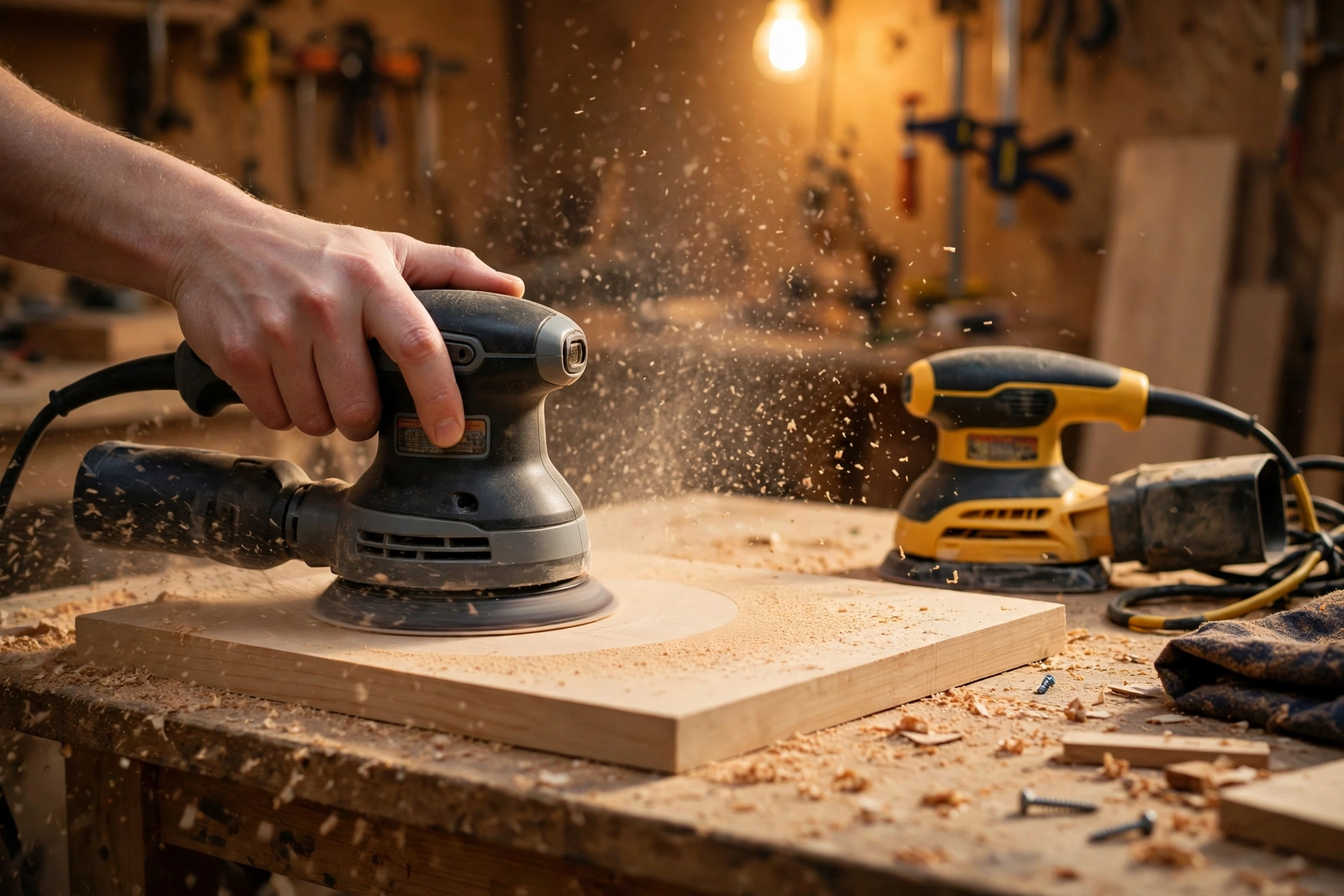
Most random orbitals come with dust collection taken seriously: a dust bag plus a vacuum port, with hole patterns in the pad (usually 8 holes) aligned to the discs. Hook it to a shop vac and dust becomes a minor issue.
Sheet sanders typically have a small dust bag and that’s it. Some have vacuum adapters, but the collection is rarely as effective — partly because the paper isn’t hole-punched for extraction the way orbital discs are.
Given that wood dust is a genuine health hazard, not just a nuisance, this matters more than the spec sheet suggests.
Winner for dust collection: random orbital sander.
Price
Sheet sanders are cheaper — typically $30–$70 for a decent one, versus $50–$120 for a random orbital. The gap isn’t enormous, but if budget is the deciding factor, the sheet sander wins twice: cheaper tool, cheaper abrasives.
That said — a $60 random orbital is one of the best value purchases in all of power tools. Don’t overthink $30.
What they actually share
For all their differences, both sanders are palm-sized finishing tools that live by the same rules: wear an N95 dust mask, connect dust collection when you can, let the sander’s weight do the work instead of pressing down, and work through grits (80 → 120 → 220) instead of jumping straight to fine. Neither replaces a belt sander for aggressive stock removal — and neither performs with dull, clogged paper.
If neither fits your job: consider a detail (mouse) sander for intricate curves and tight inside work, or a belt sander when you need to strip a lot of material fast. Different jobs, different tools.
Can one sander do everything?
Honestly? A random orbital sander covers about 90% of what a typical DIYer needs. The 10% it can’t do: square inside corners, and ultra-cheap abrasive costs.
Here’s the move many experienced woodworkers make: buy the random orbital first (it’s the workhorse), and add a cheap sheet sander later if you find yourself doing lots of finish work or cursing at corners. At $30–$50, the sheet sander is a justifiable second purchase — not a compromise first purchase.
Can I use regular sandpaper on a random orbital sander?
Not directly — random orbitals need hook-and-loop discs with dust holes that match the pad. Regular sheet paper won’t stick and will block dust extraction. Stick with proper discs; the convenience is worth it.
Which sander is best for refinishing furniture?
A random orbital sander for the broad surfaces (fast, great finish), plus a sheet sander or hand-sanding for corners and details. If you refinish often, owning both pays for itself quickly.
Do I need both, or is one enough?
One is enough for most people — make it the random orbital. Add the sheet sander when you have a specific reason (lots of trim work, tight budget for abrasives, finish-sanding obsession).
Why does my sheet sander leave marks?
Usually technique: pressing too hard, tilting the sander, skipping grits, or not keeping it moving. Keep it flat, let the weight of the tool do the work, and work up through the grits (80 → 120 → 180 → 220). Fresh paper matters more than people think.
Are expensive random orbital sanders worth it?
Up to a point. The jump from a $30 no-name to a $60–$80 name-brand (better dust collection, less vibration, longer life) is absolutely worth it. The jump from $80 to $200+ buys refinement most DIYers won’t notice. Vibration control is the main thing you’re paying for — your hands will thank you on long sessions.
What grit sandpaper should I start with?
For bare wood: 80 or 100 grit to flatten, then 120, 150, and 180–220 to finish. For between-coat sanding on finish: 220–320. Never jump more than one “step” in the grit sequence — each grit’s job is to remove the scratches from the previous one.
Bookmark This Checklist — Before You Buy a Sander — Keep This Handy
About to spend the money? Run this checklist first — every item comes straight from the comparisons in this guide.
- ✅ Dust collection that actually works — pick a sander with a dust bag AND a vacuum port. On a random orbital, the discs have dust-hole patterns (usually 8 holes on a 5″ pad) that line up with the pad — hook a shop vac to it and dust becomes a minor issue instead of a health hazard.
- ✅ Low vibration — the jump from a $30 no-name to a $60–$80 name-brand buys better dust collection, less vibration, and longer life; the $80→$200+ jump is refinement most DIYers won’t notice. Your hands will thank you on long sessions.
- ✅ Pad shape for your real work — a round 5″ pad gives the best finish but physically can’t reach square inside corners; a square quarter-sheet pad can. Lots of trim, boxes, or drawer interiors? You need the square pad.
- ✅ Do the abrasive math — orbital hook-and-loop discs cost $0.50–$1+ each; quarter-sheets of standard 9″×11″ paper cost $0.15–$0.30. Two years of regular sanding can save you $50–$100 in abrasives with the sheet sander — possibly more than the tool itself.
- ✅ Fresh paper, right grits — stock 80 → 120 → 180 → 220 and never jump more than one grit step, because each grit’s job is to remove the scratches from the previous one. Fresh paper matters more than most people think.
- ✅ Disc compatibility — random orbitals need hook-and-loop discs with dust holes that match the pad; regular sheet paper won’t stick and will block extraction. Check disc availability and price for your pad before you commit.
Grit Progression Cheat Sheet — Keep This Chart Handy
Whichever sander you buy, the grit sequence is what decides the finish. Screenshot this and keep it by the sandpaper drawer.
| Stage | Grit | Job |
|---|---|---|
| Flatten bare wood | 80 or 100 | Remove mill marks and flatten the surface |
| Smooth bare wood | 120, then 150 | Remove the scratches left by the previous grit |
| Finish bare wood | 180–220 | Final smooth surface before applying a finish |
| Between finish coats | 220–320 | Light sanding between coats of finish |
| The golden rule | Never jump more than one step | Each grit wipes out the marks left by the one before it |
| Dust collection setup | 5 in (127 mm) pad, usually 8 holes | Line the disc holes up with the pad holes and hook up a vacuum so dust stays a minor issue |
The verdict
📋 Keep This Chart Handy — Which Sander for Your Job?
| Your situation | Pick | Why |
|---|---|---|
| First/only sander | Random orbital | does 90% of everything |
| Finish work on flat surfaces | Random orbital | more forgiving finish |
| Tight budget (tool + abrasives) | Sheet sander | cheapest total cost |
| Lots of trim, boxes, inside corners | Sheet sander | square pad reaches corners |
| Refinishing furniture regularly | Both | orbital for fields, sheet for details |
| Fast stock removal | Random orbital | no contest |
First sander as a beginner? Get the random orbital. It forgives sloppy technique, removes material faster, and leaves the cleanest finish with the least skill.
On the tightest budget? The sheet sander wins on total cost — cheaper tool and the cheapest abrasives. Accept slower stock removal, and let the sander do the work instead of pressing down.
Pro or serious woodworker? Own both. The orbital does the heavy lifting on open surfaces; the sheet sander handles corners, trim, and between-coat sanding. You’ll reach for each constantly.
The random orbital sander is the right first buy for almost everyone. It’s faster, leaves a better finish with less skill, and collects dust better. The sheet sander isn’t obsolete, though — it’s the budget king with the cheapest abrasives on earth and the only one of the two that reaches corners. At these prices, “both” is a perfectly rational answer.
The Real Cost: Tool + Abrasives — Keep This Chart Handy
The price tag lies. The abrasives are the real bill — screenshot this before you buy.
| Random orbital sander | Sheet sander | |
|---|---|---|
| Tool price | $50–$120 | $30–$70 |
| Abrasive cost per piece | Hook-and-loop discs, $0.50–$1+ each | Quarter-sheets of standard 9 x 11 in (23 x 28 cm) paper, about $0.15–$0.30 each |
| Pad | 5-in (127 mm) round, usually 8 dust holes | Square/rectangular quarter-sheet pad |
| Dust collection | Usually good — dust bag plus vacuum port | Basic — often just a dust bag |
| Two years of regular sanding | Discs add up fast, especially coarse grits | Can save $50–$100 in abrasives — possibly more than the tool itself cost |
Rule of thumb from this guide: a $60 random orbital is one of the best value purchases in power tools — but if you sand a lot, the sheet sander pays you back in paper.
Keep Reading
- Sander Leaving Swirl Marks? 30-Second Fix!
- 10 Power Tools Every Beginner NEEDS (2026 Guide)!
- Brushless Tools: HYPE or Worth The Extra Money?
Related: For detail sanding in tight corners, an oscillating multi-tool with a sanding pad is hard to beat — here are 12 oscillating multi-tool uses and tricks worth knowing.
Tool Worth Lab provides research-based buying guidance. Prices are approximate US street prices and vary by retailer and sales. Always check current pricing before buying.
For official specifications and support documentation, see DeWalt’s official site.
For official specifications, see Bosch’s official site.