
Every street has one: the driveway with a perfect clean stripe down the middle and a pale ghost of grime on either side — the signature of a first-time pressure washer owner who started in the centre, at full blast, with the narrowest nozzle, and learned the hard way that this machine does not forgive enthusiasm.
Here is what nobody tells you at the hire shop: a pressure washer is the rare tool where more power makes the job worse. The trick is not a bigger machine — it is the opposite. The widest nozzle, the longest sensible distance, and a wand that never, ever stops moving. Get those three right and twenty years of grime comes off while the paint, the mortar and the wood grain stay exactly where they belong.
This guide gives you the exact nozzle, distance and motion for every surface in your home — concrete, brick, siding, deck, car — plus the six mistakes that etch, strip and shred, so the only thing that disappears is the dirt.
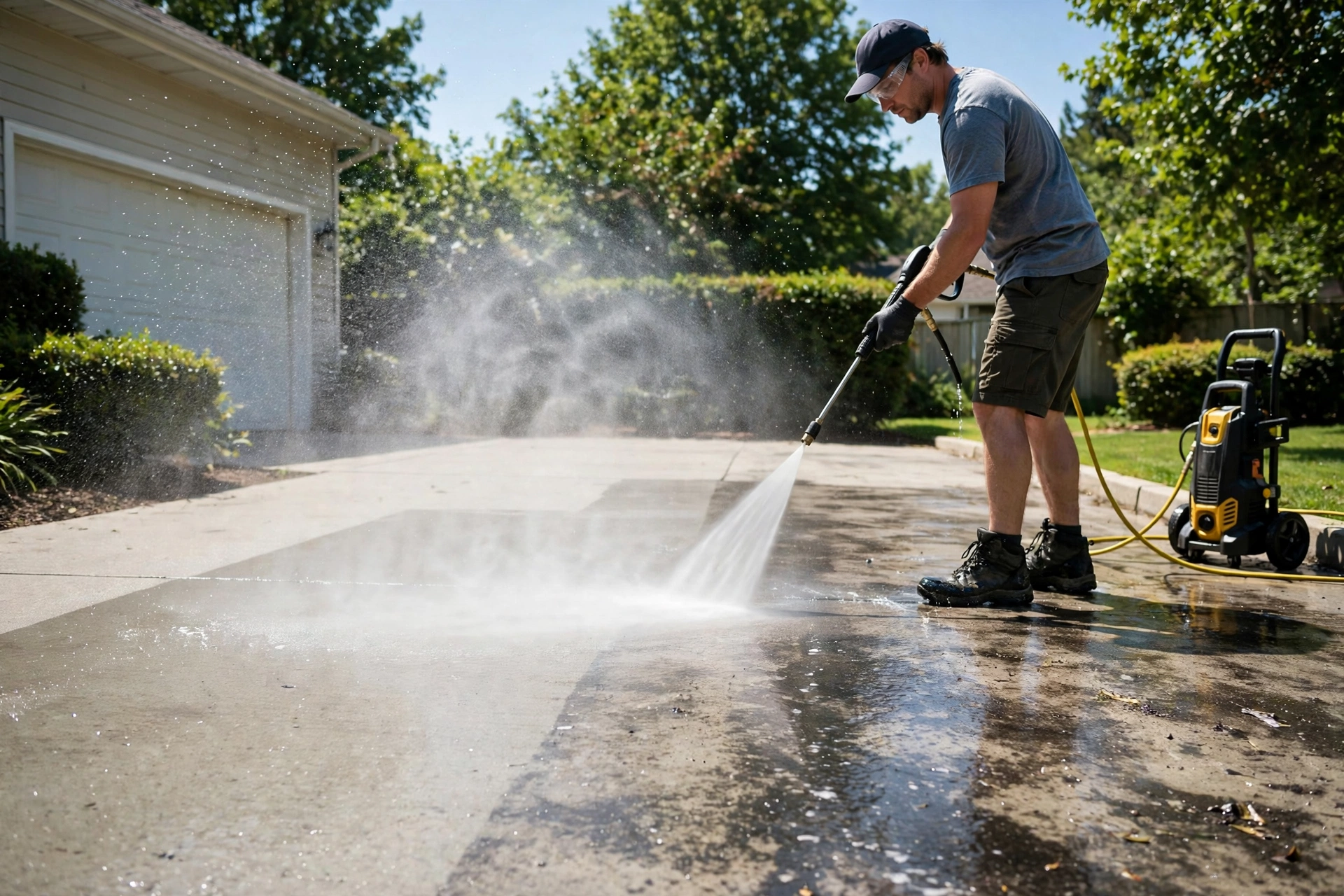
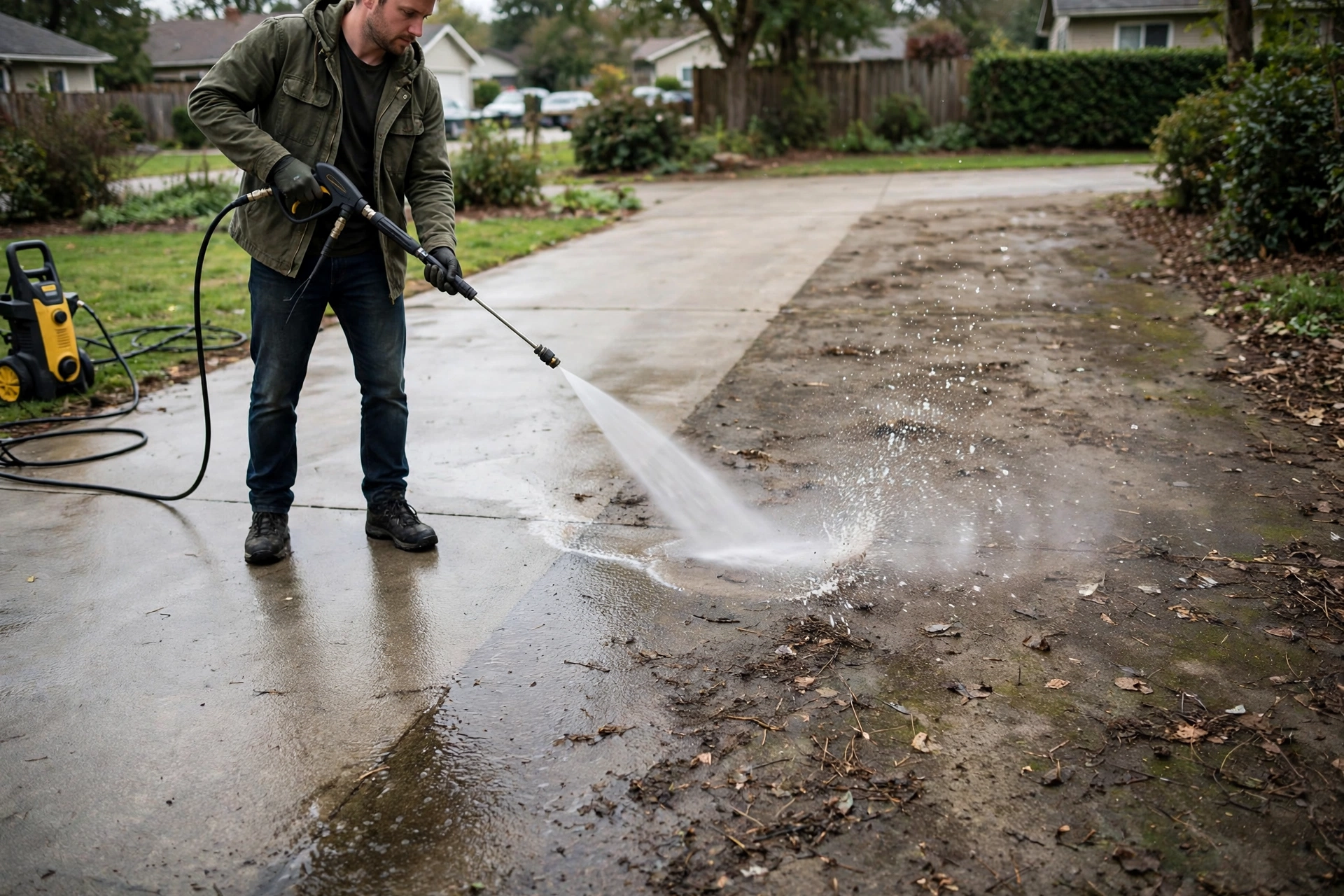
Pro tip: the white 40° nozzle is your default for everything unfamiliar — step down to green only if white isn’t cleaning. Mistake to avoid: holding the spray still in one spot; even a wide nozzle damages a surface if it lingers.
Safety first: Pressure washers can injure — the jet cuts skin (never point at people, pets, or yourself; the 0° nozzle is essentially a water scalpel). Wear eye protection and closed-toe shoes. Electric models: keep connections dry, use GFCI. Never spray electrical fixtures, outlets, or into vents.
How they work (the 30-second version)
A pressure washer takes garden-hose water and pressurizes it — typically 1,300 to 3,000+ PSI (pounds per square inch) — through a small nozzle. The pressure does the cleaning, not the water volume. More PSI = more cleaning power = more damage potential. The nozzle determines how that pressure is concentrated.
The two numbers: – PSI (pressure) — the force. Higher = more aggressive. – GPM (gallons per minute) — the flow. Higher = faster rinsing, more effective cleaning.
For homeowners: 1,800–2,300 PSI electric models handle 95% of tasks. Gas models (2,800+ PSI) are for large areas and professionals — more power than most homeowners need, with more damage risk.
Nozzles: the part that matters most
Nozzles are color-coded by spray angle. This is the single most important thing to get right.
| Color | Angle | For | Danger level |
|---|---|---|---|
| Red | 0° | Almost nothing (extreme pinpoint) | ☠️ Damages everything |
| Yellow | 15° | Tough stains, concrete (carefully) | High — keep moving |
| Green | 25° | General cleaning — the default | Medium — the workhorse |
| White | 40° | Delicate surfaces, siding, cars | Low — the safe choice |
| Black | 65° (soap) | Applying detergent only | None — no pressure |
The rules: – Start with white (40°) on any unfamiliar surface. Step down to green only if white isn’t cleaning. – The red 0° nozzle: just don’t. It concentrates full pressure into a needle jet that etches concrete, strips paint instantly, and cuts skin. Professionals use it for specific tasks; homeowners should leave it in the drawer. – Distance matters as much as nozzle: 12–18 inches for most work. Closer = exponentially more aggressive (pressure increases dramatically as distance decreases).
Pressure settings per surface
| Surface | Nozzle | Distance | Notes |
|---|---|---|---|
| Concrete/driveway | Green 25° | 8–12″ | The toughest common surface — can handle it |
| Brick | White 40° | 12″+ | Mortar is softer than brick — too close damages joints |
| Vinyl siding | White 40° | 12–18″ | Angle downward — never spray up under siding |
| Wood deck | White 40° | 12–18″ | Keep moving — lingering etches wood grain |
| Car | White 40° | 18″+ | Keep distance — paint damage is expensive |
| Patio furniture | White 40° | 12″+ | Test underneath first |
| Windows | Black soap / white | 18″+ | Low pressure only — seals and glass |
The universal technique: start far, start with the widest nozzle, test in an inconspicuous spot, then move closer or step down only as needed. You can always get more aggressive; you can’t un-etch concrete.
The technique (step by step)
1. Prepare the area
Clear the work zone, cover electrical outlets/fixtures, close windows, move anything that shouldn’t get wet. Wet surrounding plants before and after (detergent runoff harms them — pre-wetting dilutes it).
2. Apply detergent (for dirty surfaces)
Use the black soap nozzle to apply detergent from the bottom up (prevents streaking — dirty runoff over dry surface stains). Let it dwell 5–10 minutes (don’t let it dry — mist lightly if needed).
3. Wash top-down, with the grain
- Siding: top to bottom is wrong for washing (it drives dirty water into clean areas) — actually: apply soap bottom-up, rinse top-down.
- Decks: with the wood grain, never against it. Keep the wand moving in smooth, overlapping passes.
- Concrete: systematic overlapping passes, like mowing — don’t wander randomly.
4. Keep it moving
The #1 damage cause: holding the spray in one spot. A stationary jet — even with a wide nozzle — concentrates force and damages the surface. Constant motion, overlapping passes, no lingering.
5. Rinse thoroughly
Detergent residue attracts dirt and can damage surfaces if left. Rinse until the water runs clear and no suds remain.
Electric vs gas: the honest comparison
| Electric | Gas | |
|---|---|---|
| PSI | 1,300–2,300 | 2,800–4,000+ |
| Best for | Cars, siding, decks, furniture | Large driveways, commercial, paint prep |
| Noise | Quiet | Loud |
| Maintenance | None | Engine (oil, fuel, winterizing) |
| Cost | $100–$250 | $300–$600+ |
| Damage risk | Lower (less pressure) | Higher (much more pressure) |
For most homeowners: electric is the right choice — adequate power for every common task, quieter, zero maintenance, and the lower pressure is actually a safety feature (harder to damage things). Gas is for large properties and professional use.
The damage gallery (what goes wrong)
- Etched concrete: too close, too narrow a nozzle, or lingering — leaves permanent swirl marks and lines. Prevention: green nozzle, 8″+ distance, keep moving.
- Stripped paint: pressure washers strip paint effortlessly — which is great when that’s the goal (with proper technique) and terrible when it isn’t. If paint is marginal, the washer will find out.
- Shredded wood: too much pressure on soft wood (cedar, pine) fuzzes the surface permanently. White nozzle, distance, keep moving — or use a deck cleaner + garden hose for delicate wood.
- Water under siding: spraying upward drives water behind siding — into walls, causing mold and rot. Always angle downward on siding.
- Cut skin: the jet breaks skin easily, especially with narrow nozzles. The injury looks minor but drives contaminated water deep — treat seriously.
Bookmark This Checklist — The Damage-Free Wash Checklist
- Start with the white 40° nozzle on any unfamiliar surface; step down to green 25° only if white isn’t cleaning.
- Leave the red 0° nozzle in the drawer — it etches concrete, strips paint instantly and cuts skin.
- Distance first: 12–18 inches for most work (18″+ for cars and windows, 8–12″ only for concrete); closer means exponentially more aggressive.
- Test in an inconspicuous spot before the visible area.
- Keep it moving: constant motion, overlapping passes, no lingering — a stationary jet is the #1 damage cause.
- Siding: angle downward, never spray up under siding; apply soap bottom-up, rinse top-down.
- Decks: wash with the wood grain, never against it.
- Detergent: apply with the black soap nozzle, dwell 5–10 minutes without letting it dry, then rinse until water runs clear.
- Protect plants: wet them before and after so detergent runoff is diluted.
- Shutdown safely: release the trigger, switch off, then squeeze once more to release trapped pressure before changing nozzles.
Your first wash: a 15-minute practice routine
Reading about nozzles is one thing; feeling the kick of the wand is another. Before you aim a pressure washer at anything you care about, spend 15 minutes on an inconspicuous patch of concrete — a back corner of the driveway, or a paving slab you can afford to mark. This practice run teaches distance, angle, and trigger control with nothing at stake, and it prevents the classic first-timer damage: a clean stripe etched into the middle of a patio, or paint stripped off a wall in the first five seconds.
The routine, in order:
- Fit the widest nozzle you have (usually the white 40-degree tip). Start wide and gentle; you can always narrow down, but you cannot un-etch concrete.
- Start at least 60 centimetres away, at a shallow angle. Hold the wand so the spray hits the surface at roughly 30 to 45 degrees, not straight down. A straight-down jet digs; an angled jet lifts dirt and moves it along.
- Squeeze the trigger in short bursts first. Feel how the wand kicks back, and practise starting and stopping the spray before you commit to a long pass. Keep both hands on the wand.
- Move closer slowly, a few centimetres at a time, until the dirt lifts. The moment it does, that is your working distance for this surface. Note it — the same distance will be too close for wood and too far for stubborn concrete stains, which is exactly why you test per surface.
- Work in overlapping, even passes. Keep the wand moving at a steady speed, like spray-painting. Holding still in one spot, even for a second or two, is how stripes and gouges happen.
- Practise the shutdown. Release the trigger, switch the machine off, then squeeze the trigger once more to release trapped pressure before you disconnect anything or change nozzles. A pressurised hose coupling can bite.
Three first-timer mistakes to watch for. First, starting with the narrowest nozzle because it looks most powerful — it is, and that is the problem. Second, washing from the bottom of a wall upward, which leaves dirty streaks that dry into the surface you just cleaned; always work top-down on vertical surfaces. Third, forgetting that the spray bounces: water, grit, and chemical residue deflect off hard surfaces back toward your legs and face, so eye protection and closed-toe shoes are not optional extras. Fifteen careful minutes here saves a weekend of repairs later, and it turns the rest of the job from guesswork into routine.
Bookmark This Checklist — 6 Mistakes That Damage Surfaces (Avoid These)
Almost every pressure washer horror story is one of these six. Check yourself against the list before you pull the trigger:
| The mistake | What it damages | Do this instead |
|---|---|---|
| Starting with the red 0° nozzle | Etches concrete, strips paint instantly, cuts skin | Leave it in the drawer. Start with the white 40° nozzle on any unfamiliar surface |
| Holding the spray still in one spot | Etches concrete and wood grain, leaves permanent stripes — the #1 damage cause | Constant motion, overlapping passes, no lingering — even a wide nozzle damages a surface if it lingers |
| Spraying upward under siding | Drives water behind siding, into walls — mold and rot follow | Angle downward on siding, always. Apply soap bottom-up, rinse top-down |
| Rinsing a wall from the bottom up | Dirty streaks dry into the surface you just cleaned | Rinse top-down on vertical surfaces — soap goes on bottom-up, rinse goes top-down |
| Letting detergent dry on the surface | Residue attracts dirt and can damage surfaces if left | Dwell 5–10 minutes, mist lightly if needed, then rinse until the water runs clear |
| Skipping the test spot | The first pass becomes the permanent damage | Test in an inconspicuous spot, then move closer or step down only as needed — you can always get more aggressive, but damage cannot be undone |
Which Detergent for Which Mess? — Keep This Chart Handy
Water alone handles dust and light dirt. Everything else needs chemistry — and the right detergent plus lower pressure beats plain water plus maximum pressure every time:
| The mess | What to use | How to apply it |
|---|---|---|
| Dust and light dirt | Water alone — no detergent needed | Rinse with the white 40° nozzle |
| Mold and mildew on siding | House-wash detergent, or diluted bleach solution (1:10) | Apply with the black soap nozzle, dwell 10 minutes, rinse with the white nozzle top-down — never try to blast mold off with pressure alone |
| Grease and ground-in grime | Detergent — it does the chemical work so you need less pressure | Apply with the black soap nozzle from the bottom up, dwell 5–10 minutes without letting it dry, rinse until the water runs clear |
| Car wash | Automotive detergent | White 40° nozzle, 18 in+ (45 cm+) distance; never use narrow nozzles on paint |
| Delicate wood deck | Deck cleaner, scrub brush, and garden hose | Often enough on its own, with zero damage risk — soft woods like cedar and redwood are the most vulnerable |
| General dirty surface | Detergent with the black soap nozzle | Apply bottom-up (prevents streaking), dwell 5–10 minutes, rinse top-down |
Protect the garden: wet surrounding plants before and after, so detergent runoff is diluted before it reaches them.
Can I use a pressure washer on my car?
Yes — with the white 40° nozzle, 18″+ distance, and automotive detergent. It’s actually gentler than automatic car washes (no brushes). Never use narrow nozzles on paint, and avoid direct spray on chips/damaged paint (it’ll lift the edges).
Do I need detergent, or is water enough?
Water alone handles dust and light dirt. Detergent is needed for mold, mildew, grease, and ground-in grime — it does the chemical work so you need less pressure (less damage risk). The right detergent + lower pressure beats plain water + max pressure every time.
How do I clean mold off siding?
Apply a house-wash detergent (or diluted bleach solution — 1:10, with proper precautions for plants) with the soap nozzle, dwell 10 minutes, rinse with white nozzle top-down. Don’t try to blast mold off with pressure alone — you’ll damage the siding before the mold surrenders.
Can a pressure washer remove paint?
Yes — and that’s sometimes the goal (with a yellow nozzle, careful technique). But it’s uncontrolled compared to proper paint stripping methods — it removes loose paint well and sound paint poorly, leaving a patchy surface. For intentional stripping, use the right method; for cleaning, avoid paint removal.
Why does my electric pressure washer keep stopping?
Usually: thermal overload (they need cool-down breaks — check the duty cycle), water supply issues (kinked hose, insufficient flow — they need full garden-hose flow), or a clogged nozzle (remove and backflush). Gas models: the usual small-engine culprits (fuel, spark, oil).
Is it safe to pressure wash a wood deck?
Yes, with restraint — white 40° nozzle, 12″+ distance, with the grain, keep moving, and consider whether a deck cleaner + scrub brush + garden hose would suffice (often it does, with zero damage risk). Soft woods (cedar, redwood) are the most vulnerable — when in doubt, go gentler.
The verdict: the damage-free formula
Widest nozzle that works + maximum effective distance + constant motion + test spot first = clean without damage.
Start conservative on every new surface. The pressure washer rewards patience (test, adjust, proceed) and punishes confidence (full blast from 6 inches on an untested surface). Respect the tool’s power, and it transforms your property. Disrespect it, and it transforms your property differently — with etch marks.
Tool Worth Lab provides research-based technique guidance. Never point a pressure washer at people or pets, wear eye protection, and always test on an inconspicuous area first — you can’t undo etching.
Bookmark This Checklist — Pressure Washer Shutdown & Storage
The wash is not over when the surface is clean. Finish the job properly:
- Release the trigger and switch the machine off before disconnecting anything.
- Squeeze the trigger once more to bleed pressure from the wand.
- Flush detergent from the system — run clean water through the soap line until it runs clear.
- Coil hoses without kinks — a kinked supply hose starves the pump next time.
- Drain water from the pump and hoses before frost; gas models get engine winterizing per the manual (oil, fuel, storage).
- Store the nozzles together — and leave the red 0° nozzle in the drawer where it belongs.
- Wipe the machine down and check the inlet filter for debris.
- Store electric models dry and indoors — damp storage and electrics never mix.