
Somewhere in your house right now, a screw head is slowly being murdered — chewed into a shiny silver crater by the wrong driver, used with total confidence. It happens in kitchen drawers, flat-pack furniture boxes, and light-switch plates everywhere, and the murder weapon is almost never a bad tool. It is the right tool’s evil twin: same shape, wrong size.
The fix takes about five minutes: learn to tell the six drive shapes apart at a glance, plus the one size rule that stops most stripped heads before they happen. After that, the drawer full of mystery bits becomes the most useful drawer in the house. Let’s sort it out.
Time to fix that for good: which drive is which, why each one exists, and the small set of drivers that covers everything you’ll ever meet.

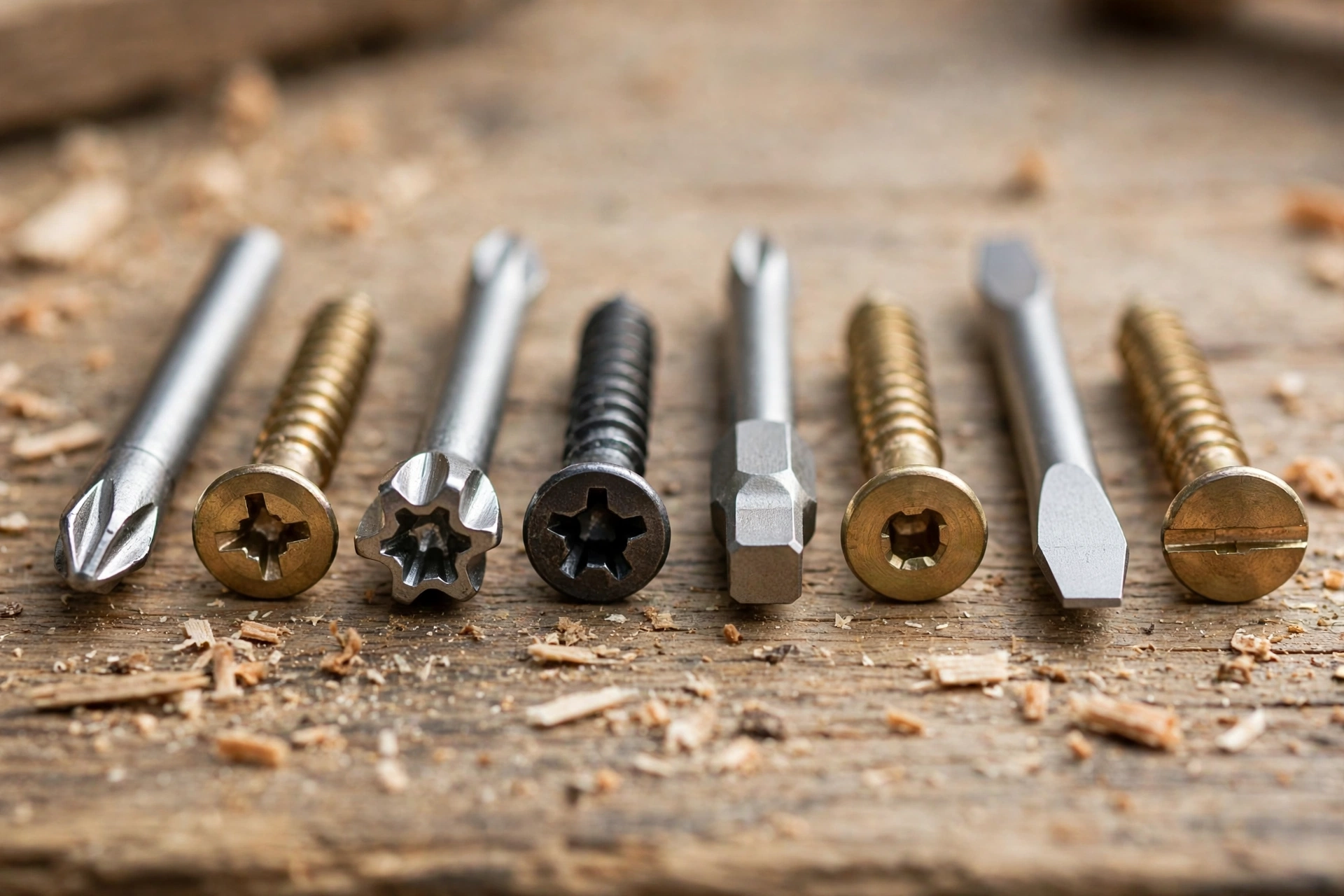
Safety first: Screwdrivers seem harmless until one slips — stab wounds from slipping screwdrivers are a genuine emergency-room category. Always push away from your body, keep your free hand clear of the slip path, and never use a screwdriver as a pry bar or chisel (the shaft isn’t designed for it and can snap).
The drive types, explained
Phillips — the most common, most hated
The cross-shaped drive found on most household screws. Designed in the 1930s intentionally to cam out (slip) at high torque — a feature for assembly lines, a curse for everyone else.
- Sizes: #0 (tiny electronics), #1 (small), #2 (the standard — 90% of Phillips screws), #3 (large).
- The #2 rule: if you’re using a Phillips and it’s not a #2, it’s probably wrong. Most stripped Phillips heads come from using #1 on a #2 screw or vice versa.
- Why it strips: the tapered design wedges upward under torque. The harder you push, the more it wants to escape. Using the wrong size multiplies this dramatically.
Torx (star) — the engineer’s choice
The six-pointed star drive. Grips on the flat sides rather than corners — vastly more torque transfer, almost no cam-out.
- Sizes: T10, T15, T20, T25 (the common ones), up to T55 for large bolts.
- Why it’s better: the star geometry means the driver can’t cam out the way Phillips does. More torque, less stripping, longer bit life.
- Where you’ll find it: automotive, electronics, appliances, modern construction screws, bicycle components. Increasingly the default for quality fasteners.
Robertson (square) — the Canadian secret
The square drive — dominant in Canada, beloved by everyone who’s tried it, mysteriously rare in the US.
- Sizes: #0, #1, #2 (the standard), #3.
- Why it’s great: the square taper grips so well the screw stays on the driver without magnets — you can drive one-handed, overhead, at angles. Almost zero cam-out.
- The tragedy: superior in almost every way to Phillips, but regional availability keeps it niche outside Canada. If you can get Robertson screws, use them.
Flathead (slotted) — the ancient one
The single-slot drive — the original screwdriver. Still found on electrical devices, vintage hardware, and applications where the slot’s simplicity matters.
- The problem: the driver slips out sideways constantly — it’s the worst drive for power and control. One slip and you’ve scratched the workpiece (or your hand).
- Still necessary: electrical terminals, some plumbing fixtures, and anywhere the manufacturer chose slotted. Keep one or two in the right sizes.
Hex (Allen) — the internal hexagon
Covered in the wrench guide — the hex socket drive is common in furniture, bicycles, and machinery. Excellent torque transfer, compact head.
The exotics (know they exist)
- Pozidriv: looks like Phillips but isn’t — an improved cross with extra tick marks. Common in European products (IKEA). Using Phillips on Pozidriv (or vice versa) strips both.
- Tri-wing / spanner / security Torx: tamper-resistant drives on electronics and public fixtures. You need the specific bit; that’s the point.
- Clutch head / Frearson: niche historical drives. You’ll encounter them in vintage restoration.
Keep This Chart Handy: Which Driver to Grab for the Screw in Front of You
Tape this inside a toolbox lid. Match the screw first, then reach for the driver — guessing is how heads get destroyed.
| Screw you are looking at | Grab this driver | Why |
|---|---|---|
| Cross-shaped head, most household screws | Phillips #2 (the standard — about 90% of Phillips screws) | #2 is the default size; #1 fits small screws and #0 fits tiny electronics, #3 fits large screws — using the wrong size is the top cause of stripped Phillips heads |
| Six-pointed star head, automotive / electronics / modern construction screws | Torx — T10, T15, T20, or T25 for common sizes (up to T55 for large bolts) | The star grips on flat sides rather than corners, so it transfers far more torque with almost no cam-out |
| Square recess, common in Canadian products | Robertson #2 (the standard) | The square taper grips so well the screw stays on the driver without magnets — one-handed driving, overhead, at angles, with almost zero cam-out |
| Single straight slot, electrical devices or vintage hardware | Flathead in the matching width | The only driver that fits; accept that it slips sideways easily and keep your free hand clear of the slip path |
| Cross with small extra tick marks between the slots (often IKEA / European products) | Pozidriv, not Phillips | Pozidriv looks like Phillips but is not interchangeable — Phillips drivers wobble in Pozidriv screws and destroy both |
| Star head with a pin in the middle (public fixtures, electronics, appliances) | Security Torx hollow-center bit | The pin blocks standard Torx bits; a security Torx bit set covers these tamper-resistant heads |
| Internal hexagon socket, furniture / bicycles / machinery | Hex (Allen) key in the matching size | Excellent torque transfer in a compact head; covered in detail in the wrench guide |
| Unfamiliar or odd drive (tri-wing, spanner, clutch head, Frearson) | The specific bit for that drive | Tamper-resistant and historical drives accept only their own bit — that is the point; a ratcheting bit driver with a compact bit case covers most of them |
Still unsure? Check the fit before turning: if the bit wobbles in the head, it is the wrong size or the wrong drive type — stop and swap, don’t force it.
Bookmark This Checklist: Diagnose the Screw Before You Touch a Driver
Thirty seconds of diagnosis beats thirty minutes of extraction. Match what you see to a row below before you turn anything.
| What you see | Likely cause | What to do |
|---|---|---|
| Bit wobbles in the screw head | Wrong size or wrong drive type — the driver does not fill the drive | Stop and swap before turning; a wobbling bit is the wrong size or the wrong drive, and forcing it destroys the head |
| Cross-shaped head that keeps camming out | Phillips taper wedging upward under torque, made worse by the wrong size, a worn tip, or too little downward pressure | Confirm it is a #2 (about 90% of Phillips screws are #2), use firm downward pressure with slow speed, and replace the driver if the cross tip looks rounded |
| Cross head with small extra tick marks between the slots | It is Pozidriv, not Phillips — common in European products and IKEA furniture | Use a Pozidriv driver; a Phillips driver wobbles in Pozidriv screws and destroys both |
| Driver slips out sideways and scratches the workpiece | Flathead (slotted) drive — the worst drive for power and control | Keep your free hand clear of the slip path, push straight, and accept the slip risk; keep one or two flatheads in the right widths for electrical terminals and vintage hardware |
| Driver held at an angle to the screw | Angled driving multiplies cam-out force | Get straight in line with the screw before applying torque — or switch to an impact driver, whose hammering action seats the bit and strips fewer Phillips heads than a drill |
| Star head with a pin in the middle | Security Torx — tamper-resistant drive on public fixtures, electronics, and appliances | Use a hollow-center security Torx bit; a standard Torx bit is blocked by the pin (security Torx bit sets run about $10–$15) |
| Head already chewed beyond recognition | Previous wrong-size or wrong-type driving | Rescue in order: rubber band between driver and screw, then locking pliers on the head, then a screw extractor as last resort |
Why screws strip (and how to stop it)
Stripping is almost never about strength — it’s about fit:
- Wrong size driver — the #1 cause. A #1 Phillips in a #2 screw contacts only the tip — it cams out instantly. Match the size exactly: the driver should fill the drive with no wobble.
- Wrong drive type — Phillips in a Pozidriv screw (or vice versa) looks right and destroys both. Check for the tick marks (Pozidriv) before assuming Phillips.
- Worn driver tip — a rounded Phillips tip is a stripping machine. Inspect your most-used drivers; replace the #2 when the cross gets rounded.
- Angled driving — the driver must be straight in line with the screw. Any angle multiplies cam-out force. This is why impact drivers (which hammer downward while turning) strip fewer Phillips heads than drills.
- Too much speed, not enough pressure — with Phillips especially: firm downward pressure + slow speed beats fast spinning every time. Let the driver seat fully before applying torque.
The stripped-screw rescue: rubber band between driver and screw (fills the gaps), then locking pliers on the head, then screw extractor as last resort.
Manual vs powered: when to use each
- Manual screwdriver: for small screws, delicate work, final tightening (feel matters), and anything where power would overdrive. The precision tool.
- Impact driver: for driving screws in volume — the hammering action seats the bit and prevents cam-out. Dramatically fewer stripped heads than a drill.
- Drill with clutch: the middle ground — the adjustable clutch prevents overdriving. Set it light and work up.
Never: use a drill at full speed with no clutch on small screws — that’s how you strip every head and snap small screws simultaneously.
Keep This Chart Handy — Screwdriver, Drill, or Impact Driver? Pick by the Job
Matching the driver to the screw is only half the battle — the other half is picking the right tool to turn it with. Screenshot this before your next job.
| Job in front of you | Grab this | Why |
|---|---|---|
| Small screws, delicate work, final tightening | Manual screwdriver | Feel matters here — power would overdrive the screw. The precision tool. |
| Driving screws in volume | Impact driver | The hammering action seats the bit and prevents cam-out — dramatically fewer stripped heads than a drill. |
| General driving where you want control | Drill with clutch | The adjustable clutch prevents overdriving. Set it light and work up. |
| Screws inside tight cabinets | Stubby driver | A full-length driver cannot turn in the space — the stubby earns its place here. |
| Odd sizes — Pozidriv, security Torx, small hex | Ratcheting bit driver with a compact bit case | One case covers the unusual drives without a drawer full of individual drivers. |
| Electronics and eyeglasses | Precision set (#0 Phillips, small Torx) | The $10 precision sets are fine — just do not use them for anything bigger, they will snap. |
Never use a drill at full speed with no clutch on small screws — that is how you strip every head and snap small screws at the same time.
The minimal screwdriver collection
| Driver | Sizes | Approx. cost |
|---|---|---|
| Phillips screwdrivers | #1, #2 (get two #2s) | $10–$20 |
| Torx set (bits or drivers) | T10–T30 | $12–$20 |
| Robertson | #2 | $5–$8 |
| Flathead | 2 sizes | $8–$12 |
| Precision set (electronics) | #0 Phillips, small Torx | $10–$15 |
| Total | ~$45–$75 |
Plus a ratcheting bit driver with a bit set ($20–$30) for the odd sizes — the bit set handles Pozidriv, security Torx, hex, and everything unusual in one compact case.
Bits, holders, and the workshop screwdriver setup
Once you own the right drivers, the next problem is keeping the bits usable. A drawer of loose bits is where good screwdrivers go to die: tips get nicked against each other, the size you need hides under a pile of adapters, and a worn bit keeps getting used because nobody notices it is worn. A small amount of organisation here prevents most of the stripping this guide is about.
Start with the bit itself, not the handle. Inspect your most-used bits — especially #2 Phillips — every few months. A fresh bit has crisp, sharp edges; a worn one looks rounded or polished at the corners. The difference in grip is dramatic, and a worn bit strips screws that a new bit would drive cleanly. Bits are cheap and replaceable by design, so treat them as consumables: when a #2 starts slipping on screws it used to grip, throw it away rather than compensating with more force. The same applies to screwdriver tips on fixed drivers — a driver with a visibly rounded tip is not a keepsake, it is a screw-stripper.
Magnetic tips help, but know their limits. A magnetised tip holds a screw on the driver for one-handed starts in awkward spots, which is genuinely useful overhead or inside cabinets. Magnetisers are inexpensive, and a few passes through one magnetises a bit; the reverse side demagnetises it. The trade-off: a magnetised bit attracts metal filings and workshop dust, which then grind into the screw head. Keep magnetised bits in a closed case, wipe them before use on clean work, and do not use them around sensitive electronics or magnetic storage. A bit holder with a strong magnet at the base does the same job for driving while keeping the bit itself cleaner.
Choose the holder for the job, not the biggest set. A stubby driver earns its place for screws in tight cabinets where a full-length driver cannot turn. A ratcheting bit driver with a compact bit case covers the odd sizes — Pozidriv, security Torx, small hex — without a drawer full of individual drivers. And a simple bit rail or labelled case, with sizes marked, beats a 100-piece jumble every time: you can see at a glance which size is missing, and you stop buying your fourth #2 bit because you could not find the third. The goal is not more bits. It is the right bit, in good condition, findable in ten seconds, every time you reach for it.
Bookmark This Checklist: Keep Your Bits Gripping Like New
A worn bit strips screws that a new bit would drive cleanly — and the difference in grip is dramatic. Tape this list inside the toolbox lid and run it every few months.
- Inspect your #2 Phillips first. A fresh bit has crisp, sharp edges; a worn one looks rounded or polished at the corners. Check your most-used bits — especially the #2 — every few months.
- Throw a slipping #2 away. When a #2 starts slipping on screws it used to grip, replace it rather than compensating with more force. Bits are cheap and replaceable by design.
- Magnetise for awkward spots. A magnetised tip holds a screw on the driver for one-handed starts overhead or inside cabinets. A few passes through a magnetiser magnetises a bit; the reverse side demagnetises it.
- Keep magnetised bits cased and clean. Store them in a closed case and wipe them before use on clean work — they pick up metal filings and workshop dust, which then grind into the screw head.
- Keep magnets away from electronics. Do not use magnetised bits around sensitive electronics or magnetic storage.
- Store sizes where you can see them. Use a bit rail or labelled case with sizes marked — #2 Phillips, T10–T30 Torx, #2 Robertson — so you can see at a glance which size is missing instead of buying your fourth #2 because you could not find the third.
The goal is not more bits. It is the right bit, in good condition, findable in ten seconds, every time you reach for it.
Keep Reading
- How to Fix a Stripped Screw Hole (7 Methods, Easiest First)
- Impact Wrench vs Driver: 90% Get This WRONG!
- Drill Bit Types Explained: Twist, Brad-Point, Forstner & More
What’s the difference between Phillips and Pozidriv?
Pozidriv has additional small tick marks between the cross slots and a different taper angle — it’s designed not to cam out. They look similar but aren’t interchangeable: Phillips drivers wobble in Pozidriv screws, and Pozidriv drivers bottom out in Phillips screws. Check for the tick marks.
Why does my #2 Phillips keep slipping?
Either it’s actually worn (inspect the tip — rounded = replace), the screw is actually Pozidriv (check for ticks), or you’re not applying enough downward pressure. Also: cheap #2 bits vary in actual size — a quality bit fits noticeably better.
Are ratcheting screwdrivers worth it?
For high-volume hand driving: yes — the ratcheting action is much faster than lift-and-turn. For occasional use: a standard driver is fine. They’re a comfort/convenience upgrade, not a capability one.
What screwdriver do I need for eyeglasses/electronics?
A precision set with #000, #00, #0 Phillips and small Torx (T4–T8). The $10 precision sets are fine — just don’t use them for anything bigger (they’ll snap).
Why do some screws have a pin in the middle (security Torx)?
Tamper resistance — public fixtures, electronics, and some appliances use them to prevent casual disassembly. Security Torx bit sets ($10–$15) include the hollow-center bits. It’s a minor inconvenience, not real security.
Should I buy a huge 100-piece bit set?
The mid-range 50–70 piece sets from reputable brands are genuinely useful — they cover every drive type you’ll encounter. The ultra-cheap 100+ piece sets have soft bits that deform and strip screws worse than having no bit at all. Quality over quantity.
The verdict
Match the driver to the drive — exactly, not approximately. Use #2 Phillips for #2 Phillips screws (not #1, not “close enough”). Prefer Torx and Robertson when you have the choice (they’re objectively better drives). Apply firm downward pressure with Phillips. And keep your #2 tips fresh — a $6 replacement driver prevents $60 of stripped-screw misery.
The screwdriver is the simplest tool in the box and the most misused. Respect the fit, and stripping becomes a rare event instead of a constant companion.
Tool Worth Lab provides research-based buying guidance. Prices are approximate US street prices and vary by retailer. Always push screwdrivers away from your body, and never use one as a pry bar.