
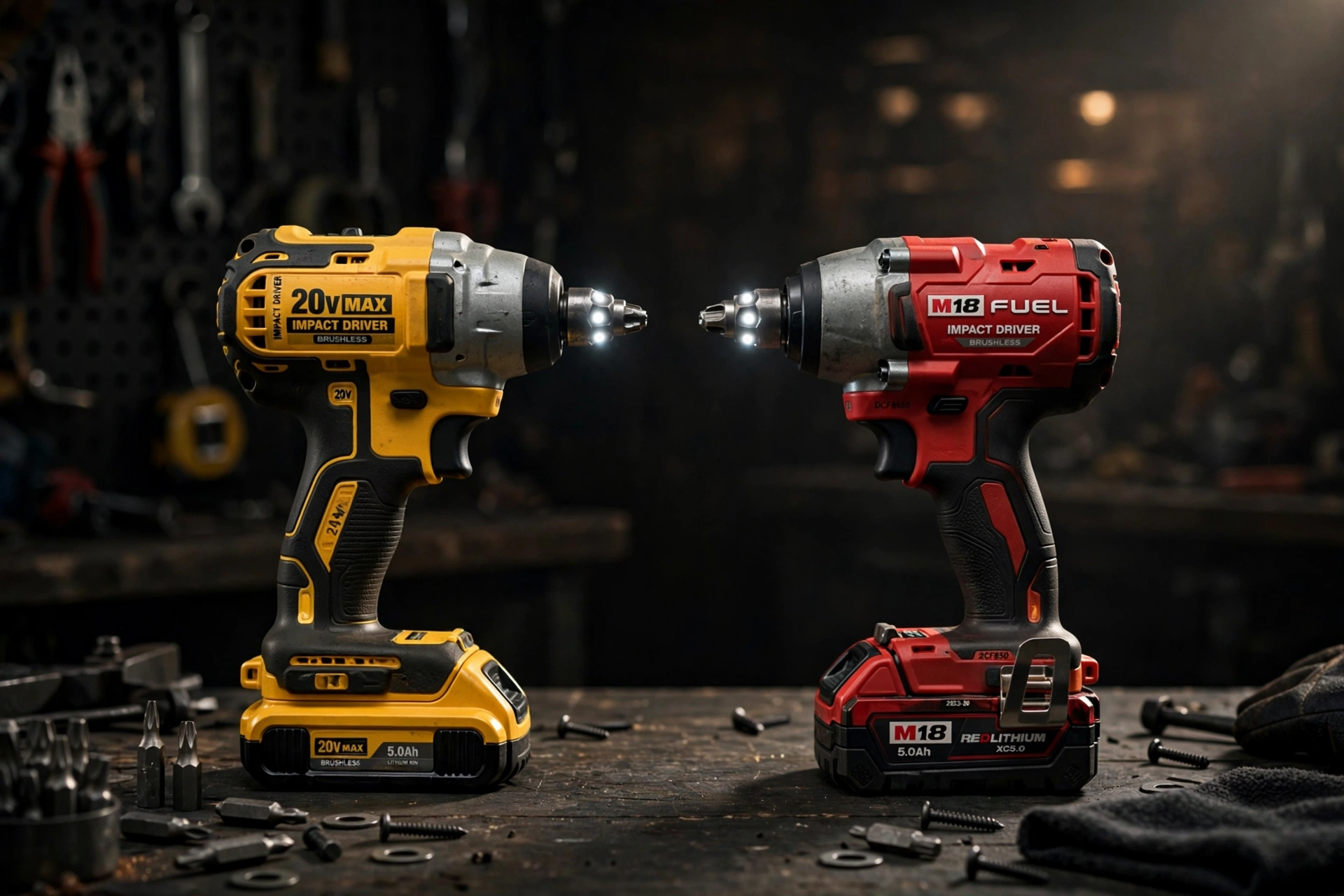
Quick Answer: Milwaukee wins on power and warranty, DeWalt on price and comfort — but for most buyers, buy whichever matches the batteries you already own.
Two thousand versus one thousand eight hundred and twenty-five. On paper, that torque gap looks like the whole story — the kind of number that sells drills. In your garage, driving ordinary screws into ordinary lumber, it decides almost nothing.
The differences that actually matter are the ones you can feel in your hand and see in your tightest corner: a head that squeezes into cabinets the other one cannot reach, a grip that fits your palm, a work light that leaves no shadows. Ten seconds holding each one tells you more than the whole spec sheet — here is the five-minute check that settles it.

Related reading: Is Milwaukee Worth the Premium Over Ryobi for DIY? (Honest Answer)
impact wrench vs impact driver — don’t confuse the two
How this comparison was made: This is a research-based buying guide comparing published manufacturer specifications, warranty terms, and typical street pricing — not a hands-on lab test. Specs are approximate and manufacturers update models; always verify current specs before buying.
Quick answer
| DeWalt DCF887 (20V Max) | Milwaukee 2853-20 (M18 Fuel) | |
|---|---|---|
| Max torque | ~1,825 in-lbs | ~2,000 in-lbs |
| Max RPM | ~3,250 | ~3,600 |
| Max IPM | ~3,600 | ~4,400 |
| Length | ~5.3″ | ~4.5″ |
| Typical bare-tool price | ~$99–$129 | ~$129–$149 |
| Warranty | 3 years | 5 years |
| Verdict | Best value, great ergonomics | Most power, toughest build |
Bottom line: Milwaukee wins on raw power and durability. DeWalt wins on price and comfort. For most users, buy whichever matches the batteries you already own — that’s worth more than any spec difference.
Head-to-head: the specs
Power and torque
Milwaukee’s M18 Fuel impact driver delivers around 2,000 in-lbs of torque vs DeWalt’s ~1,825 in-lbs. Milwaukee also leads on speed: 3,600 RPM / 4,400 IPM vs DeWalt’s 3,250 RPM / 3,600 IPM.
On paper, Milwaukee wins. In practice? Both drive 3″ screws into lumber all day without breaking a sweat. The torque gap only matters in extreme work — long lag bolts, dense hardwoods, or all-day production driving. For typical DIY and even most pro finish work, both have power to spare.
Size and ergonomics
Milwaukee’s 2853 is notably compact at around 4.5 inches long — one of the shortest in its class, which matters in tight spaces like inside cabinets. DeWalt’s DCF887 is about 5.3 inches.
Ergonomics are subjective, but DeWalt’s grip is widely praised as one of the most comfortable — slightly slimmer handle, well-balanced. Milwaukee’s grip is excellent too, just shaped differently. If possible, hold both in a store; your hand will pick a winner in ten seconds.
Battery platform
This is where the decision often gets made for you:
- DeWalt 20V Max: huge platform (200+ tools), batteries are everywhere, often cheaper. If you own DeWalt tools, the DCF887 is the obvious pick.
- Milwaukee M18: equally huge (250+ tools), plus the M12 line for compact tools. Milwaukee’s High Output batteries are among the best in the business for sustained power.
Switching platforms for one tool is almost never worth it. A new battery and charger adds $100+ to the “cheaper” option instantly.
which battery platform you should buy into
Build quality
Both are jobsite-grade, but Milwaukee has a slight edge in perceived toughness — better dust sealing, metal-reinforced designs, and a reputation earned on rough jobsites. DeWalt is no slouch; its tools survive professional use daily. But in the “which survives being dropped off a ladder” contest, Milwaukee usually gets the nod.
Warranty
- DeWalt: 3-year limited warranty.
- Milwaukee: 5-year limited warranty.
Two extra years of coverage is meaningful, especially on a tool you’ll use heavily. Point to Milwaukee.
Price
DeWalt typically undercuts Milwaukee by $20–$40 on comparable kits and bare tools. Sales narrow or erase the gap regularly — both brands discount aggressively around holidays. Never pay full price; wait for a sale or a “buy the kit, get a free tool” promotion.
Bookmark This Chart: feature face-off — DeWalt DCF887 vs Milwaukee 2853-20
Beyond the spec sheet, these are the practical differences you’ll actually feel on the job:
| Feature | DeWalt DCF887 | Milwaukee 2853-20 | Edge |
|---|---|---|---|
| Speed control | 3 modes + PrecisionDrive (great anti-cam-out) | 4-mode drive control incl. self-tapping mode | Milwaukee, slightly |
| Work light | Single bright LED, 20-min shutoff | Tri-LED, fewer shadows | Milwaukee |
| One-handed bit change | Yes | Yes | Tie |
| Noise | Loud — wear hearing protection | Loud — wear hearing protection | Tie (both scream) |
| Length | 5.3″ (135 mm) | 4.5″ (114 mm) | Milwaukee — fits tighter spots |
Who should buy the DeWalt DCF887?
- You already own DeWalt 20V batteries
- Value matters — it’s typically the cheaper option
- You prioritize comfort for all-day use
- DIY to light-pro use
- You want the best-reviewed ergonomics in the class
Who should buy the Milwaukee 2853-20?
- You already own M18 batteries
- Maximum power and compactness matter
- You’re hard on tools (jobsite conditions)
- You want the longest warranty (5 years)
- Heavy/professional daily use
What DeWalt and Milwaukee Actually Share
Before the head-to-head, here’s what both drivers give you — because the common ground is bigger than the rivalry suggests:
- Brushless motors, professional grade. Both are jobsite-tough, brushless drivers built for daily work — not homeowner toys. With normal use, either one lasts a decade or more.
- More power than you need. Both drive 3-inch screws into lumber all day without breaking a sweat. The torque gap only matters for extreme fastening — big lag bolts, dense hardwoods.
- Real speed control. Multiple speed/torque modes on both (Milwaukee’s 4-mode drive control, DeWalt’s 3-mode system with PrecisionDrive) so you stop snapping screws and stripping heads.
- One-handed bit insertion and LED work lights. Both have them. Once you’ve used one-handed bit changes, you’ll never go back.
- Massive battery platforms behind them. DeWalt 20V Max (200+ tools) and Milwaukee M18 (250+ tools, plus M12) — whichever you buy into, you’re not buying into a dead end.
- They’re both loud. No winner here — wear hearing protection for extended driving with either one.
Translation: there’s no bad choice on this page, only a better-for-you choice. The chart below makes it in one glance.
Keep This Chart Handy — Tight-Space Test: Measure the Gap Before You Pick a Head Length
Head length is the one tight-space figure this guide actually sizes: Milwaukee 2853-20 at about 4.5″ (114 mm), DeWalt DCF887 at about 5.3″ (135 mm) — a difference of about 0.8″ (20 mm), which the guide calls nearly an inch. Measure your tightest gap first, then read the row that matches it. This test covers head length only; allow extra room beyond the head for the bit and fastener, which this guide does not size.
| Your tightest gap (head room only) | What the two head lengths tell you | Decide this way |
|---|---|---|
| Under 4.5″ (114 mm) | Neither head length alone clears it | Do not buy on head length — re-measure, check the angle you can actually work at, and remember the bit and fastener still need room beyond the head. |
| Between 4.5″ (114 mm) and 5.3″ (135 mm) | Milwaukee’s ~4.5″ (114 mm) head fits the head-length test; DeWalt’s ~5.3″ (135 mm) head does not | This is the only gap band where head length alone separates the two — the guide’s own tight-space example is working inside cabinets. |
| Over 5.3″ (135 mm) | Both heads clear the head-length test | Head length stops deciding anything. Decide on the guide’s real decider instead: whichever brand’s batteries you already own, since switching platforms adds $100+ for a battery and charger. |
| Gap clears, but you will hold it all day | Comfort is the tie-breaker, not length | DeWalt’s grip is praised in this guide as one of the most comfortable, with a slightly slimmer handle and good balance — if possible, hold both in a store, because your hand will pick a winner in ten seconds. |
| Gap is fine, but the fastener is extreme | Torque, not length, is the question | Both drivers handle typical work — both drive 3″ (76 mm) screws into lumber all day. The torque gap (~2,000 in-lbs / ~226 N·m for Milwaukee versus ~1,825 in-lbs / ~206 N·m for DeWalt) only matters for extreme fastening such as big lag bolts, structural screws, and dense materials. |
Keep This Chart Handy — Which Impact Driver for YOUR Job?
| Your situation | My pick | Why |
|---|---|---|
| Casual DIY — furniture assembly, small repairs | Either | Both drive 3-inch screws into lumber all day without breaking a sweat. Buy whichever kit is cheaper — or whichever matches your batteries. |
| Deck building and long lag bolts | Milwaukee 2853-20 | ~2,000 in-lbs of torque (vs DeWalt’s ~1,825) gives you more headroom on long fasteners in dense lumber. |
| Auto work and tight spaces | Milwaukee 2853-20 | Only ~4.5 inches long (DeWalt is ~5.3 inches) — it fits where the DeWalt can’t. |
| You already own DeWalt or Milwaukee batteries | Match your batteries | Batteries cost more than the bare tool. Never start a second platform for one driver. |
Bookmark This Checklist — 6 Rookie Mistakes That Wreck Screws and Blame the Driver
Most stripped heads and snapped screws are not the driver’s fault. Run through this list before you blame the tool — every mistake below is fixable in seconds.
- Buying the cheaper driver, then a battery and charger on top. Switching platforms for one tool adds $100+ and wipes out whatever the cheaper driver saved you. Match the batteries you already own.
- Choosing by torque alone. 2,000 vs 1,825 in-lbs looks decisive, but both drive 3-inch (76 mm) screws into lumber all day. The gap only matters for extreme fastening like big lag bolts and dense hardwoods.
- Ignoring head length. Milwaukee is about 4.5 inches (114 mm), DeWalt about 5.3 inches (135 mm). Measure your tightest gap first, especially inside cabinets.
- Paying full price. Both brands discount aggressively around holidays. Wait for a sale or a buy-the-kit-get-a-free-tool promotion.
- Using a battery adapter across brands. Adapters exist but void warranties and can cause performance or safety issues. Do not use them.
- Skipping hearing protection. Both drivers are loud. Wear hearing protection for extended driving with either one.
- Forgetting the speed modes. Milwaukee’s 4-mode drive control and DeWalt’s 3-mode system with PrecisionDrive stop snapped screws and stripped heads. Use them.
Keep Reading: Driver Smarts & Next Buys
- Impact Driver vs Drill: What’s the Difference? — if you’re still on the fence about whether you even need an impact driver.
- DeWalt DCD771C2 Review — DeWalt’s classic drill/driver kit, the natural teammate for the DCF887.
- Milwaukee vs Ryobi: Is Premium Really Worth It? — how Milwaukee’s red lineup compares when the budget actually matters.
Can I use DeWalt batteries in Milwaukee tools (or vice versa)?
No — battery systems are proprietary and physically incompatible. Third-party adapters exist but void warranties and can cause performance or safety issues. Don’t.
Is 1,825 vs 2,000 in-lbs a noticeable difference?
For 95% of tasks, no. Both are far more powerful than the job requires. The difference shows up only in extreme fastening — big lag bolts, structural screws, dense materials.
Which impact driver is better for a beginner?
Whichever brand’s starter kit is on sale. Seriously — for a first impact driver, price and battery platform matter 10x more than the spec sheet. Both are professional-grade tools that will outlast your learning curve.
Should I buy the kit or the bare tool?
If you don’t own batteries in that platform, buy the kit — the included batteries and charger cost far less bundled than separately. If you’re already on the platform, bare tool.
Do I even need an impact driver, or is my drill enough?
If you drive more than a handful of screws regularly, an impact driver is transformative — faster, less wrist strain, fewer stripped screws. It’s the single best upgrade after a drill for most DIYers.
How long do these impact drivers last?
With normal use, a decade or more. Brushless motors (both of these are brushless) have dramatically longer lifespans than the brushed motors of old. The batteries will need replacing long before the tool dies.
impact driver vs drill: what’s the difference
Print This Before You Buy — Kit or Bare Tool? The Total-Cost Checklist
The bare-tool price is never the whole price. Run your situation through this checklist before checkout — the wrong choice quietly adds a battery and charger to the bill.
| Your situation | Buy this | Why |
|---|---|---|
| You own no batteries in that platform | The kit | Bundled batteries and charger cost far less together than bought separately |
| You already own that platform’s batteries | Bare tool only | Never start a second platform for one driver — a new battery and charger adds $100+ at once |
| You are comparing bare-tool prices alone | DeWalt DCF887 typically ~$99–$129; Milwaukee 2853-20 typically ~$129–$149 | The gap is only $20–$40, and sales plus holiday promotions narrow or erase it regularly — never pay full price |
| You want the longest cover on a heavily used tool | Milwaukee 2853-20 | 5-year limited warranty against DeWalt’s 3-year warranty — two extra years where it counts |
| Your work is mostly inside cabinets and tight spaces | Milwaukee 2853-20 | Head length about 4.5″ (114 mm) against DeWalt’s about 5.3″ (135 mm) — it fits where the DeWalt cannot |
| This is your first impact driver ever | Whichever brand’s starter kit is on sale | Price and battery platform matter far more than the spec sheet for a first driver — both are professional-grade tools that outlast the learning curve |
The verdict
| Your situation | Buy this |
|---|---|
| Already on DeWalt 20V | DeWalt DCF887 — obvious choice |
| Already on Milwaukee M18 | Milwaukee 2853-20 — obvious choice |
| Starting fresh, budget matters | DeWalt — usually cheaper, equally capable |
| Starting fresh, want max toughness | Milwaukee — power + 5-year warranty |
| Tight spaces / compactness priority | Milwaukee — shorter head length |
| Comfort for all-day driving | DeWalt — superb ergonomics |
Here’s the thing the fanboys won’t admit: you cannot make a bad choice here. Both are professional-grade, brushless, reliable, and backed by massive battery platforms. The battery platform you own (or choose) matters more than the tool — so pick your color, buy on sale, and get to work.
Tool Worth Lab provides research-based buying guidance. Specs and prices are approximate and change over time — verify current details before buying.
Pingback: DeWalt DCD771C2 Review: Is It Still Worth Buying in 2026? - Tool Worth Lab
Pingback: Impact Driver vs Drill: What's the Difference? (And Which Do You Need?) - Tool Worth Lab
Pingback: DeWalt 20V vs Milwaukee M18: Which Battery Platform Should You Buy Into? - Tool Worth Lab
Pingback: Why Does My Drill Keep Stripping Screws? (Causes & Fixes) - Tool Worth Lab
Pingback: Is Milwaukee Worth the Premium Over Ryobi for DIY? (Honest Answer) - Tool Worth Lab