
Quick Answer: Under the marketing, both systems are 18V nominal. For pros pushing tools to the limit daily, Milwaukee M18's edge can justify the premium. For homeowners and weekend DIYers, the gap rarely justifies the price — buy DeWalt 20V and pocket the difference.
Pick the wrong battery platform and you will spend the next ten years quietly paying for it — every new tool, every spare battery, every charger locked to a colour you chose on a Tuesday afternoon in a hardware store. Pick right, and you will barely think about it again. The maddening part? Both batteries run at the same nominal voltage, both brands make superb tools, and the internet’s brand war will not help you decide.
So here is the honest way to choose: forget the logos for a minute and think about your actual life — who you borrow batteries from, how many tools you will really own, and whether you are buying for weekend projects or for a living. This guide puts DeWalt 20V and Milwaukee M18 head to head on the things that actually cost you money, then tells you exactly which one fits your situation.

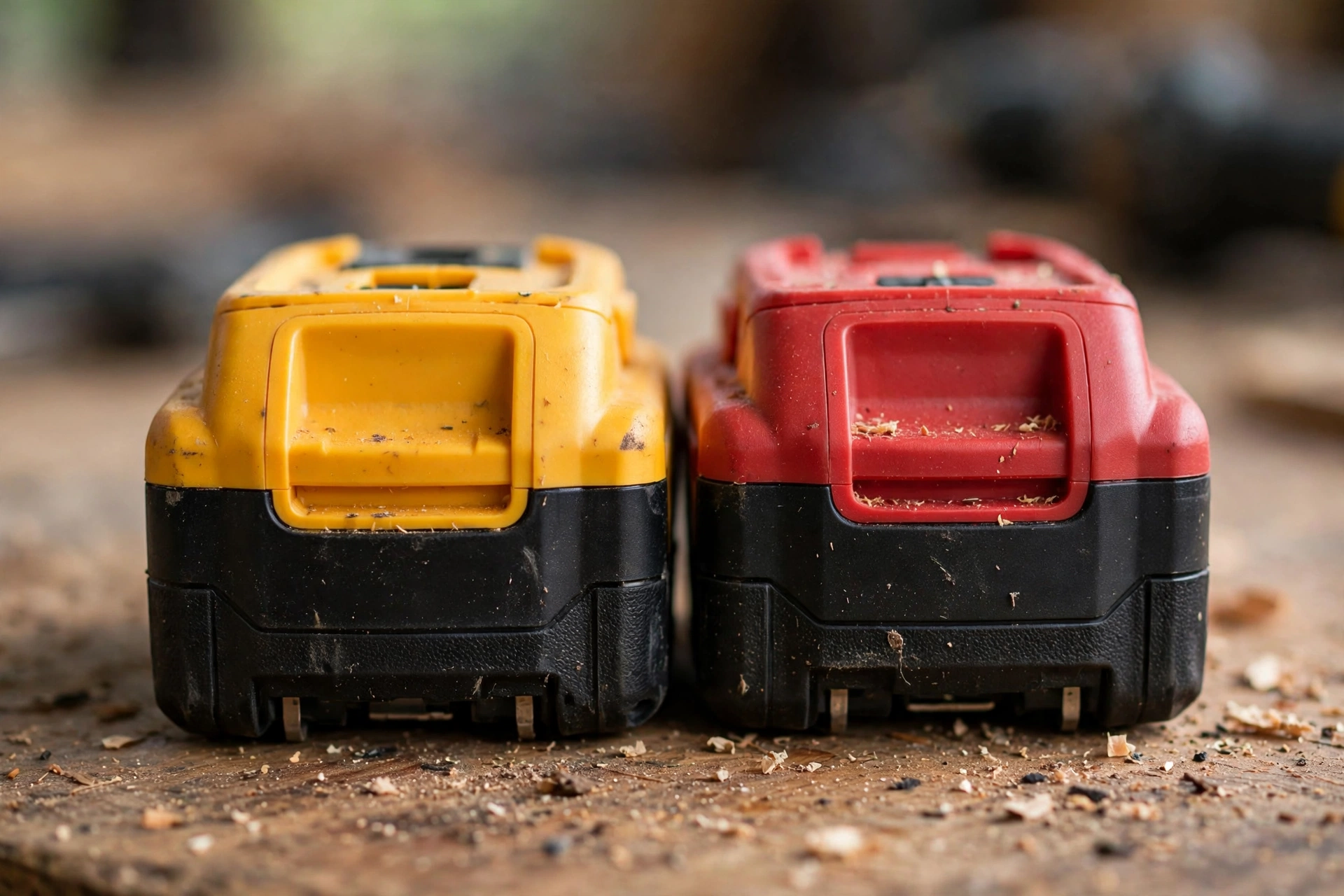
Here’s the honest breakdown.
Related reading: How Long Do DeWalt 20V Batteries Last? (Runtime + Lifespan Explained)
The short answer for your situation
| DeWalt 20V | Milwaukee M18 | |
|---|---|---|
| Tool range | Huge — 200+ tools | Huge — 250+ tools |
| Performance | Excellent | Excellent (often class-leading) |
| Price | Slightly cheaper overall | Slightly premium |
| Availability | Everywhere | Everywhere |
| Best for | Value-conscious buyers, wide range | Pros, max performance seekers |
| Ecosystem lock-in | Strong | Strong |
The honest translation: both are elite platforms. You will not regret either. The differences are at the margins — pick based on the factors below, then stop second-guessing.
Battery-line specs, side by side (manufacturer specs — “20V MAX” means 20V at full charge, 18V nominal):
| Spec | DeWalt 20V MAX | Milwaukee M18 |
|---|---|---|
| Voltage line | 20V MAX* (18V nominal) | 18V |
| Biggest battery | 12.0Ah (XR) | 12.0Ah (REDLITHIUM HD) |
| Tools in the line | 200+* | 250+* |
| Performance tier | XR / FlexVolt Advantage | Fuel / High Output |
| Battery crossover | FlexVolt 60V batteries also run 20V tools | Every M18 battery runs every M18 tool |
* Manufacturer-claimed specs.
Head-to-head: your money and your workload
Tool selection
Both ecosystems are enormous. Milwaukee’s M18 line is slightly broader, especially in plumbing, electrical, and specialty trade tools. DeWalt’s 20V covers everything a DIYer or general contractor needs, plus strong outdoor (60V FlexVolt) crossover. Winner: Milwaukee, narrowly — but only tradespeople will notice.
The manufacturers’ own counts: DeWalt lists 300+ products in the 20V MAX line, and Milwaukee lists 250+ solutions in the M18 system — either way, you are buying into one of the two largest cordless ecosystems on sale.
Performance
In head-to-head tool tests, Milwaukee wins slightly more often than not — particularly in high-demand tools like impact wrenches and grinders. DeWalt is right there, and sometimes wins (their FlexVolt advantage tools are beasts). Winner: Milwaukee, by a nose. For DIY use, the difference is invisible.
Batteries
Both offer compact to high-capacity options (up to 12Ah). Milwaukee’s High Output batteries run cooler under load; DeWalt’s FlexVolt batteries work across 20V and 60V tools — a genuine versatility advantage. Winner: Tie — different strengths.
Price
DeWalt is generally 10–15% cheaper across comparable tools and kits, with more aggressive sales (Father’s Day, Black Friday deals are legendary). Milwaukee holds value better and discounts less. Winner: DeWalt for budget; Milwaukee for resale.
Warranty and service
Both offer 3-year limited warranties with good service networks. Milwaukee’s service reputation is marginally stronger among pros. Winner: Tie.
The factor that actually matters: what do people around you use?
This sounds silly, but it’s the most practical advice: batteries are shareable. If your brother, neighbor, or jobsite crew runs Milwaukee, your dead battery becomes a non-issue — borrow one. Platform choice is partly a social decision. Ask around before committing.
Bookmark This Checklist — The Platform-Commitment Audit (Do This Before You Buy In)
You are signing up for 5–10 years, not one weekend project. Run through this audit honestly before you spend a cent — it takes five minutes and can save you a full rebuy later.
- List your next 10 tools. Both lines are huge (DeWalt lists 300+ products in 20V MAX; Milwaukee lists 250+ solutions in M18), but check the specific tools you will actually buy — especially plumbing, electrical, or specialty trade tools, where Milwaukee’s range runs slightly broader.
- Count your circle. Ask your brother, neighbours, and jobsite crew which brand they run. A borrowed battery turns a dead pack into a non-issue — and that social backup is worth more than any spec-sheet win.
- Price the whole kit, not the drill. DeWalt is generally 10–15% cheaper across comparable tools and kits, with aggressive holiday sales; Milwaukee discounts less but holds resale value better. Budget buyers and premium buyers are playing different games.
- Count chargers and packs, not just tools. Both lines top out at a 12.0Ah pack, and batteries are proprietary — one brand’s pack will not power the other’s tools. Every extra platform means more batteries and chargers to buy, store, and keep charged.
- Check the outdoor crossover. DeWalt’s FlexVolt batteries work across 20V and 60V tools; Milwaukee’s M18 Fuel line covers its own outdoor range. If mowers, trimmers, or blowers are on your list, factor that in now.
- Know your exit price. Selling a kit used typically recovers only about 50–60% of what you paid, and you will rebuy batteries and chargers from scratch. If that number stings, that is your sign to audit harder, not buy faster.
- Remember the warranty baseline. Both offer 3-year limited warranties with good service networks, so warranty alone should not decide this — fit, circle, and budget should.
If you can tick every line with a straight face, buy in and stop second-guessing. If two or more lines are blank, you are not ready yet — and waiting beats switching later.
Picked the wrong platform? Here’s what switching costs
Yes, but it stings. Selling a kit used recovers maybe 50–60% of what you paid, and you’ll rebuy batteries and chargers. That’s why this decision matters upfront. The good news: there’s no wrong answer here — both platforms will serve you for a decade or more.
Bookmark This Chart: what switching platforms really costs
Nobody switches for fun — but if you must, here’s the honest math. Resale figures are typical ranges for tools in good condition; your exact numbers will vary.
| What you own | Typical resale recovery | What you must rebuy | Out-of-pocket to switch |
|---|---|---|---|
| Starter kit (drill + 2 batteries + charger) | 50–60% | New kit in the other brand | Roughly half a new kit |
| 5-tool collection | 45–55% | Batteries, charger + bare tools | Several hundred dollars |
| 10+ tools, deep in | 40–50% | Full battery fleet + chargers | Often $1,000+ |
The cheat code: instead of switching, buy the one standout tool from the other brand as a bare tool plus a single battery and charger. You get the best of both worlds without the divorce.
What about Ryobi, Makita, Bosch?
Yes, the big two aren’t your only options. Ryobi 18V is the budget king — far cheaper and surprisingly capable for light DIY. Makita’s 18V LXT line is excellent, especially outside the US, and Bosch 18V is solid but smaller in North America. Tight budget: Ryobi. Pro tier: DeWalt versus Milwaukee.
- Ryobi 18V: the budget king — far cheaper, surprisingly capable, best for light DIY. Not in the same performance league, but unbeatable value.
- Makita 18V LXT: excellent, especially globally — slightly less US retail presence than the big two.
- Bosch 18V: solid, underrated — smaller ecosystem in North America.
If budget is tight, Ryobi deserves a serious look. If you’re going pro-tier, it’s DeWalt vs Milwaukee.
Keep This Chart Handy — When to Skip the Big Two (Ryobi, Makita, Bosch)
DeWalt and Milwaukee are not your only options — and for some buyers, they are the wrong ones. Match your situation before you commit to a decade of one brand’s batteries:
| Your situation | Look at | Why it fits |
|---|---|---|
| Tight budget, light DIY | Ryobi 18V | The budget king — far cheaper and surprisingly capable for light DIY, with unbeatable value; not in the same performance league as the pro lines |
| You will own three tools total | Ryobi 18V | A pro platform only pays off if your collection grows — for three tools, save the money |
| Buying outside the US, or you want the strongest global line | Makita 18V LXT | Excellent, especially outside the US — slightly less US retail presence than the big two, but a serious pro-tier line |
| You want a solid, underrated option | Bosch 18V | Solid and underrated — but a smaller ecosystem in North America, so check the specific tools you need first |
| Going pro-tier, buying for a living | DeWalt 20V vs Milwaukee M18 | This is the real pro-tier contest — run the decision table above and pick by budget, circle, and workload |
Keep Reading: more head-to-head guides
Still deciding where your money goes? These break it down further:
- DeWalt vs Milwaukee: I Wasted $500 Testing Both (One Is a SCAM) — the tool-level showdown between the two brands’ flagship drivers.
- Milwaukee vs Ryobi: Is Premium REALLY Worth It? — an honest take on whether a home DIYer even needs a pro platform.
- Brushless Tools: HYPE or Worth The Extra Money? — the motor tech sitting inside both brands’ flagship lines.
Is Milwaukee really worth the premium over DeWalt?
For pros pushing tools to the limit daily — often yes. For homeowners and weekend DIYers — the performance gap rarely justifies the price gap. Buy DeWalt and pocket the difference.
Can DeWalt 20V batteries work in Milwaukee tools?
No — and no safe adapter exists that we’d recommend. Battery platforms are proprietary. (Cheap adapters exist online; they bypass safety electronics. Don’t.)
Which platform has better sales?
DeWalt — their holiday kit deals are consistently the best value in power tools. Patient buyers save serious money.
Should a beginner buy into a pro platform?
If you plan to grow your collection over years — yes. Starting on a pro platform means every future purchase compounds. If you’ll own three tools total, save money with Ryobi.
Do I need to stick to one brand forever?
No — many people run two platforms (e.g., Milwaukee for work tools, Ryobi for garden). But each additional platform means more batteries and chargers, so there’s a real cost to splitting.
Which is better for outdoor power equipment?
Both have strong OPE lines (DeWalt 60V FlexVolt, Milwaukee M18 Fuel OPE). EGO and Greenworks lead the dedicated OPE space, but within these platforms, you’re covered for mowers, trimmers, and blowers.
DeWalt vs Milwaukee — which battery platform should I choose?
First-time buyers and budget-focused DIYers get more value from DeWalt 20V; contractors and tradespeople pushing tools daily get their money’s worth from Milwaukee M18. Either way, you’re locking in a 5–10 year platform — match your situation to the decision table above before you buy.
Bookmark This Chart: which battery to buy first on your platform
The platform decision is only half the purchase — the first battery you buy shapes every job after it. Both lines top out at a 12.0Ah pack, both run 18V nominal (labelled 20V MAX on DeWalt), and every battery in a line powers every tool in that line. Match the pack to the work:
| Your situation | Buy this pack first | Why it fits |
|---|---|---|
| Light DIY: screws, shelves, flat-pack furniture | Compact pack | Lightest and cheapest way in; still runs every tool in the line |
| One battery for a bit of everything | Mid-size/high-capacity pack | Noticeably longer runtime than a compact pack without flagship weight or price |
| Daily hard work: grinders, saws, impact wrenches | 12.0Ah flagship pack — DeWalt XR or Milwaukee REDLITHIUM HD | Maximum runtime; Milwaukee High Output packs run cooler under heavy load |
| Outdoor tools plus workshop tools (DeWalt only) | FlexVolt 60V pack | FlexVolt 60V batteries also run 20V tools, so one battery family covers mower and drill |
| Already own tools in one brand | Same-brand pack, same voltage line | Every M18 battery runs every M18 tool; adding a second brand means a second set of batteries and chargers |
What DeWalt and Milwaukee actually share (nobody argues about this)
For all the fanboy fighting, these two platforms are shockingly similar where it counts: same nominal voltage under different stickers, the same 12.0Ah battery ceiling, the same one-brand lock-in, the same everywhere availability, and the same elite pro tier with hundreds of tools. Before you agonize over the differences, get this straight:
- Same voltage, different stickers: “20V MAX” means 20V at full charge, 18V nominal — the same nominal voltage as Milwaukee’s M18.
- Same battery ceiling: both top out at a 12.0Ah pack — DeWalt’s XR on one side, Milwaukee’s REDLITHIUM HD on the other.
- Same lock-in: batteries from one brand won’t power the other’s tools, so the ecosystem hold is equally strong both ways.
- Same shelf space: both are available everywhere, so neither side wins on finding batteries, chargers, or replacement parts.
- Same elite tier: both are top-tier pro platforms with hundreds of tools in the line — 200+ and 250+ respectively. You won’t regret either; the differences are at the margins.
That’s the relief: there is no catastrophic wrong answer here. The choice is about fit — your budget, your circle, your workload — not about dodging a dud.
The verdict
Keep This Chart Handy: pick your platform in 30 seconds
| Your situation | Pick this | Why |
|---|---|---|
| First-time buyer building a collection | DeWalt 20V | Lower entry price, and a huge line to grow into |
| Already own DeWalt 20V tools | Stay with DeWalt | Your batteries are the investment — switching means rebuying |
| Already own Milwaukee M18 tools | Stay with Milwaukee | Same reason — platform lock-in cuts both ways |
| Budget-focused DIYer | DeWalt 20V | Deeper holiday deals and kit discounts |
| Contractor pushing tools daily | Milwaukee M18 | Class-leading trade tools and a stronger pro service network |
Stop agonizing: both DeWalt 20V and Milwaukee M18 are phenomenal platforms that will last you a decade. Pick the one that fits your budget and your circle, buy in, and get to work. The tools don’t build the project — you do.
Tool Worth Lab provides general DIY information only. Power tools can cause serious injury — when in doubt, consult a qualified professional.
Pingback: 10 Essential Power Tools Every Beginner Should Own (2026) - Tool Worth Lab
Pingback: How Long Do DeWalt 20V Batteries Last? (Runtime + Lifespan Explained) - Tool Worth Lab
Pingback: How to Store Power Tool Batteries So They Last for Years - Tool Worth Lab
Pingback: DeWalt vs Ryobi: Which Is Better for Homeowners? - Tool Worth Lab
Pingback: DeWalt vs Milwaukee Impact Driver: Which Is Better? - Tool Worth Lab