
The wrong pliers do not just fail — they wreck the thing you are holding. One squeeze with the wrong jaws and a nut’s corners are gone for good, a wire comes away with a tag on the end, or the tips slip off a pin you have been chasing for ten minutes. On the shelf they all look identical: same shape, same promise, same shrug from the packaging. In your hand, the difference is instant.
The fix is not buying more pliers — it is learning the handful of shapes that actually matter. Get those right and five pairs cover almost every gripping and cutting job you will ever meet; get them wrong and even the most expensive set in the shop will let you down at the worst moment.
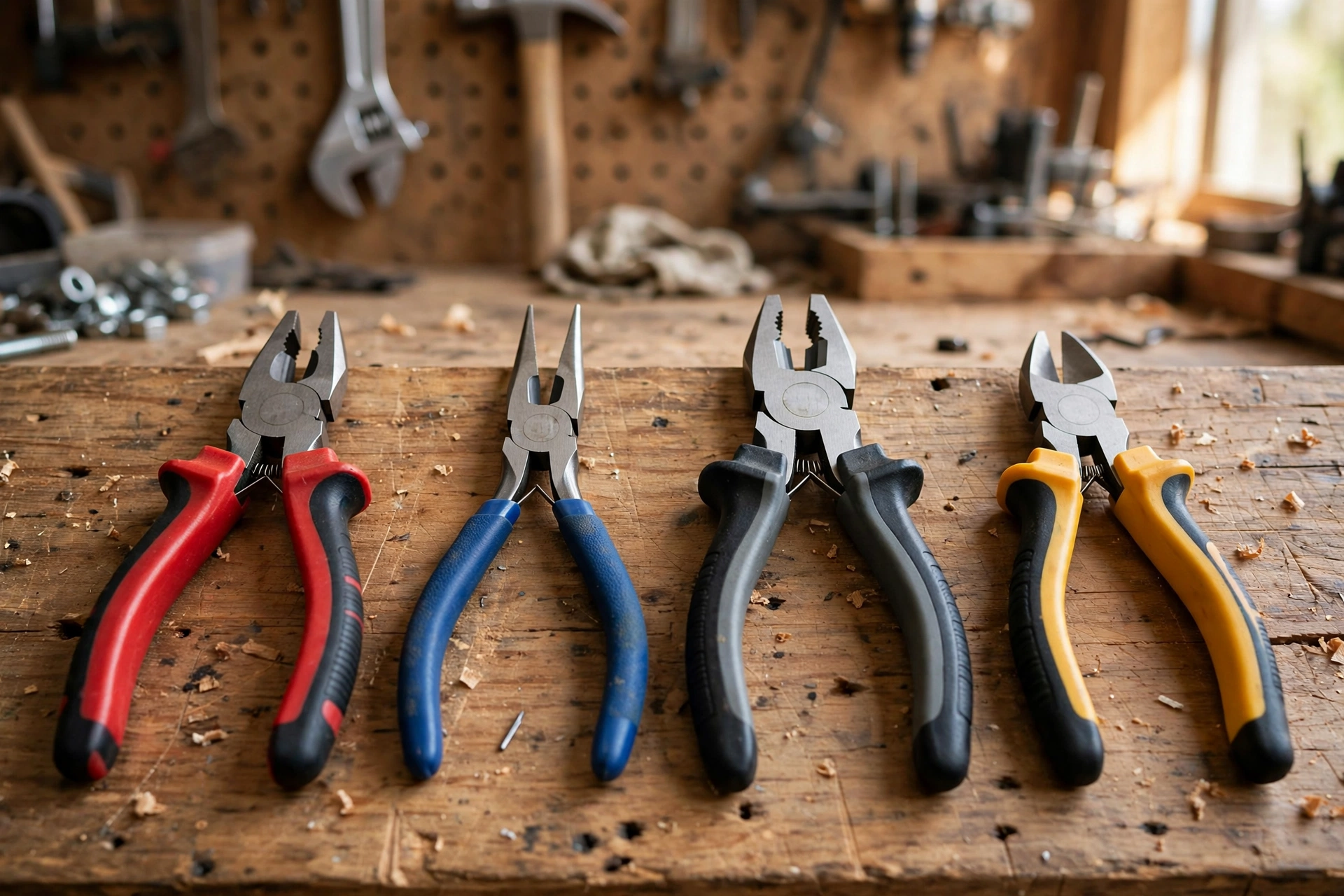
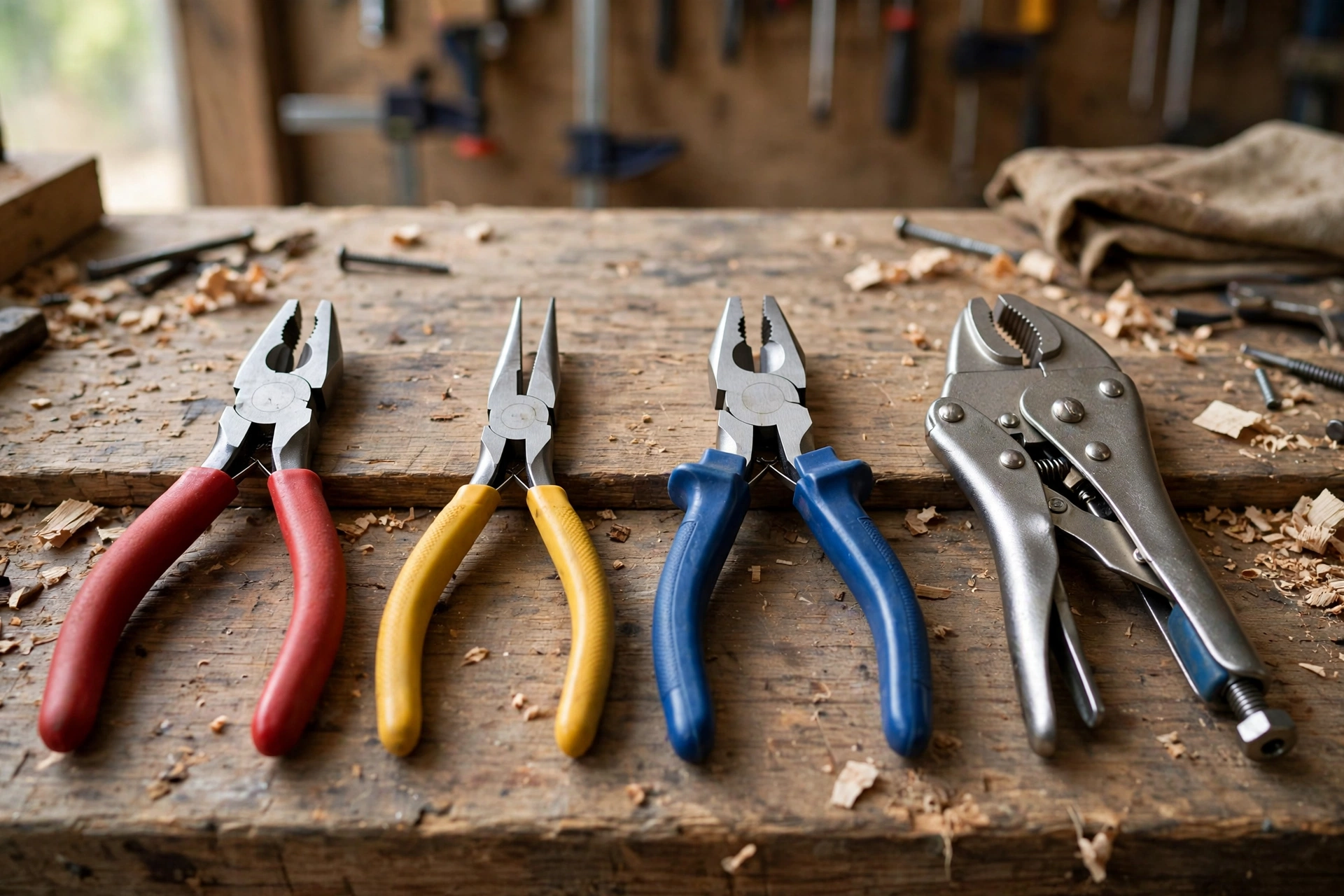
Safety first: Pliers aren’t dangerous, but misuse is — never use pliers as a hammer, never cut live electrical wire (verify power is off, then verify again), and wear eye protection when cutting wire (cut ends fly). Pliers are gripping and cutting tools, not striking tools.
The core types
Slip-joint pliers — the generalist
The classic household pliers — flat jaws with a slip joint that adjusts between two positions for different grip widths.
- For: general gripping, bending, holding — the “grab it and turn it” tool.
- Limitations: the jaws aren’t specialized for anything; it’s the jack-of-all-trades that does everything adequately and nothing excellently.
You need one pair (8″) — it’s the default pliers for the junk drawer and the toolbox alike.
Needle-nose pliers — the precision grip
Long, tapered jaws that reach into tight spaces and grip small objects precisely.
- For: bending wire, reaching into electronics and tight assemblies, holding small parts, jewelry and craft work, fishing hooks out of places fingers can’t go.
- Variants: bent-nose (angled jaws for awkward angles), long-reach (extra-long for deep access).
You need one pair (6–8″) — the second pliers after slip-joint, and the one you’ll reach for constantly in detail work.
Locking pliers (Vise-Grip style) — the third hand
Clamp onto an object and stay — the adjustable jaw locks with tremendous force, freeing your hands.
- For: holding parts for welding/soldering, gripping stripped screws and bolts (the jaws bite where wrenches slip), clamping as a temporary vise, extracting broken fasteners.
- The stripped-screw saver: when a screw head is too damaged for a screwdriver, locking pliers on the head often succeed where everything else fails.
You need: one medium (10″) and ideally one small (5–6″) — they’re the “problem solver” pliers that rescue bad situations.
Diagonal cutting pliers (dikes) — the wire cutter
Angled jaws designed purely for cutting wire and small pins — not for gripping.
- For: cutting copper wire, trimming component leads, cutting cable ties, snipping small nails and brads.
- Not for: gripping (the jaws are ground for cutting, not holding), or cutting hardened steel (it’ll notch the jaws — use bolt cutters for hardened).
You need one pair (6–7″) if you do any electrical, electronics, or craft work.
Lineman’s pliers — the electrician’s hammer
Heavy, robust pliers with gripping jaws, cutting edges, and often a crimping section — the electrician’s primary tool.
- For: gripping, twisting wire (splicing), cutting heavier wire, and — famously — light hammering in a pinch (the flat face invites it, though it’s still not a hammer).
- Best for: electrical work, heavy wire manipulation, situations needing maximum gripping force.
You need these if you do electrical work beyond basic outlet swaps. For general DIY, slip-joint + dikes cover the ground.
Groove-joint pliers (tongue-and-groove / Channellock style) — the big grip
Long handles, adjustable jaw positions, enormous gripping capacity — for large nuts, pipes, and fittings.
- For: plumbing (large fittings, supply lines), automotive (large nuts), anything too big for normal pliers.
- The plumbing essential: when a pipe wrench is overkill and an adjustable wrench doesn’t fit, groove-joint pliers are the answer.
You need: one 10″ pair if you do plumbing or automotive work. The 12″ for larger jobs.
Crimping pliers — the connector tool
Designed to crimp terminals onto wire — insulated, non-insulated, coaxial, ferrules, depending on the die.
- For: automotive wiring, marine wiring, electronics — anywhere you’re attaching terminals to wire ends.
- Not interchangeable: using regular pliers to crimp gives weak, unreliable connections that fail. The crimping die shapes the terminal correctly.
You need these if you do wiring beyond twisting wire nuts — a basic crimper ($15–$25) transforms connection quality.
Snap-ring pliers — the specialist
For installing and removing circlips/snap rings — the retaining rings in machinery, transmissions, and tools.
- For: exactly one job — snap rings. Nothing else does it.
- You need these only when you encounter snap rings (machinery repair, automotive transmissions, tool rebuilding). Buy the set (internal + external, several sizes) when the job demands it.
The minimal pliers collection
| Pliers | Size | Approx. cost |
|---|---|---|
| Slip-joint | 8″ | $12–$20 |
| Needle-nose | 6–8″ | $12–$20 |
| Locking pliers | 10″ | $12–$20 |
| Diagonal cutters | 6–7″ | $12–$20 |
| Groove-joint | 10″ | $15–$25 |
| Total starter set | ~$63–$105 |
Add lineman’s, crimping, and snap-ring pliers as your work demands them. Five pairs cover 95% of life’s gripping and cutting.
Quality matters more with pliers than most hand tools
Cheap pliers fail in specific, annoying ways:
- Jaw misalignment — the tips don’t meet, so they can’t grip small objects (the main job of needle-nose).
- Soft steel — jaws deform, cutters dull instantly on wire, pivot loosens.
- Bad pivot — wobbly, imprecise, exhausting to use.
The test: close the pliers and look at the jaw tips — they should meet precisely with no gap and no overlap. Open and close — the action should be smooth with no grinding or excessive play. Mid-range pliers ($12–$25 per pair) from reputable brands pass this test; bargain-bin pliers often don’t.
This is a buy-once category — quality pliers last decades. The price difference between frustrating and delightful is about $8 per pair.
Which Pliers for Which Job? — Keep This Chart Handy
| Your job | Reach for | Size |
|---|---|---|
| General gripping, bending, and holding | Slip-joint pliers | 8 in (about 20 cm) |
| Tight spaces, small parts, electronics, and detail work | Needle-nose pliers | 6–8 in (about 15–20 cm) |
| Holding a part hands-free, or gripping a stripped screw or bolt | Locking pliers | 10 in (about 25 cm); small 5–6 in (about 13–15 cm) for tight spots |
| Cutting wire and small pins only | Diagonal cutting pliers | 6–7 in (about 15–18 cm) |
| Large nuts, pipes, and plumbing fittings | Groove-joint pliers | 10 in (about 25 cm); 12 in (about 30 cm) for larger jobs |
| Attaching terminals to wire ends | Crimping pliers, with the die matched to the terminal type | As the crimping job requires |
| Installing or removing snap rings (circlips) | Snap-ring pliers, internal and external set | As the snap ring requires |
Start with the first five rows. Add the last two rows only when a real job demands them.
Bookmark This Checklist — The In-Store Pliers Check Before You Pay
- Close the jaws and look at the tips in good light: the tips should meet exactly, with no gap and no overlap — a gap means small objects will keep slipping.
- Open and close the pliers ten times: the action should feel smooth, with no grinding and no wobble at the pivot.
- Hold the pliers the way the job will demand: a pair that digs into the palm on the third squeeze will punish the hand on the thirtieth, and the heaviest pair is not the best pair for overhead or tight-cabinet work.
- Buy the five core pairs first — slip-joint 8 in (about 20 cm), needle-nose 6–8 in (about 15–20 cm), locking 10 in (about 25 cm), diagonal cutters 6–7 in (about 15–18 cm), and groove-joint 10 in (about 25 cm) — and add lineman’s, crimping, or snap-ring pliers only when a real job demands them.
- Aim for mid-range quality, about $12–$25 per pair from a reputable brand: quality pliers are a buy-once category and last decades, while bargain-bin pliers often fail on jaw alignment, soft steel, or a bad pivot.
- Keep pliers for gripping, cutting, and holding — never as a hammer and never as a substitute wrench, since serrated jaws chew up fastener flats; the one exception is a fastener that is already ruined, where locking pliers are the rescue tool.
What I actually carry — and the pliers mistakes that cost me real money
I learned most of this the expensive way, not from a chart. My first pliers set was a bargain five-pack, about $20 for the lot, and it taught me exactly why cheap pliers are not a bargain. The needle-nose pair looked fine in the packaging, but the tips did not meet — there was a visible gap when closed. I discovered that while trying to pull a cotter pin out of a gate hinge, and the pin just kept slipping. I ended up buying a single decent needle-nose pair for $16, which is more than the whole bargain set cost, and I have used it weekly ever since. That is the pliers lesson in one story: one good pair beats five bad ones.
The second expensive lesson was a rounded bolt. I was removing an old bathroom faucet and grabbed slip-joint pliers because they were closest. The nut was already stiff with limescale, the serrated jaws slipped, and by the third try the corners were gone. A wrench would not grip it after that. What saved the job was a pair of locking pliers clamped hard onto what was left of the nut — they bit, they held, and the nut turned. Now my rule is simple: if a fastener is already damaged, or even looks like it might be, I reach for the locking pliers first, not last. It is the difference between a ten-minute job and a Saturday spent drilling a nut out.
The third mistake was cutting the wrong wire with the wrong tool. I snipped a piece of hardened fencing wire with my diagonal cutters, and it left a notch in both jaws that never came out. Every soft copper cut after that left a little tag on the wire. A replacement pair cost $14, which is not a fortune, but it was entirely avoidable: hardened wire gets bolt cutters or a hacksaw, never the fine cutting edges of dikes. I keep that notched pair in a drawer as a reminder, and I do not lend it to anyone.
Here is what actually lives in my toolbox now, and what it cost, roughly: slip-joint 8 inch, needle-nose 8 inch, locking pliers 10 inch, diagonal cutters 7 inch, and groove-joint 10 inch. Total, bought one pair at a time over a couple of years, around $85. No snap-ring pliers, because I have never needed them, and no crimper until the year I rewired a trailer and suddenly needed one every weekend. That is the right way to build the set: buy the five core pairs, then add a specialist only when a real job demands it, not because a set looks complete on a shelf.
If you are buying in a store, do the three checks before you pay. First, close the jaws and look at the tips in good light — they should meet exactly, with no gap and no overlap. Second, open and close the pliers ten times — the action should feel smooth, not gritty or wobbly at the pivot. Third, hold them the way you would actually work: a pair that digs into your palm on the third squeeze will punish you on the thirtieth. Weight matters too. The heaviest pair is not the best pair if you are working overhead or in a tight cabinet for an hour.
One last firm opinion: stop using pliers as a wrench. I know everyone does it, I have done it, and almost every rounded nut in my house has that story behind it. Pliers grip by serration and force, which is exactly what chews up fastener flats. The one exception is a fastener that is already ruined, where locking pliers are the rescue tool, not the first choice. For everything else, the wrench types guide exists for a reason — use the tool shaped for the job, and keep the pliers for gripping, cutting, and holding.
What’s the difference between pliers and wire cutters?
Wire cutters (dikes) are a type of pliers optimized purely for cutting — the jaws are hardened and angled for shearing wire. General pliers can cut soft wire but do it badly and damage their jaws. Use the right one: dikes for cutting, pliers for gripping.
Can I use pliers instead of a wrench?
In an emergency, briefly — but pliers’ serrated jaws damage fastener flats, and the grip is less secure than a proper wrench. Every “pliers instead of wrench” episode risks a rounded bolt. Use the right wrench.
Why do my wire cutters have notches in the jaws?
Those are probably not wire cutters — combination/lineman’s pliers often have cutting sections plus gripping jaws. True diagonal cutters have smooth, angled cutting jaws only.
How do I cut a live wire safely?
You don’t — verify power is off first (non-contact voltage tester, then test the circuit), then cut. “Careful” cutting of live wire isn’t a skill, it’s a gamble. De-energize, verify, then work.
Are expensive pliers worth it?
Up to the mid-range ($15–$25/pair), absolutely — jaw alignment, steel quality, and pivot smoothness all improve meaningfully. Beyond that, you’re paying for ergonomics, finish, and brand. The sweet spot is firmly mid-range.
What pliers do I need for jewelry/craft work?
Needle-nose (gripping/bending), round-nose (looping wire — the tapered round jaws form perfect loops), and flush cutters (trimming wire ends flat). A basic jewelry pliers set ($15–$25 for 3–5 pieces) covers it.
Bookmark This Checklist — 5 Pliers Mistakes That Cost Real Money
Every row below already happened — to real pliers, on real jobs. Read it once, then never pay for the same lesson twice.
| The mistake | What it costs you | Do this instead |
|---|---|---|
| Buying a bargain five-pack with tips that do not meet | A visible gap when closed — small objects keep slipping; a cotter pin that will not come out of a gate hinge. | Buy one good pair and check the tips meet exactly, with no gap and no overlap. |
| Grabbing slip-joint pliers for a stiff, limescale-covered nut | Serrated jaws slip and round the corners for good — then no wrench will grip it either. | Reach for locking pliers first on any fastener that is already damaged, or looks like it might be. |
| Snipping hardened fencing wire with diagonal cutters | A notch in both jaws that never comes out — every soft copper cut after leaves a little tag on the wire. | Hardened wire gets bolt cutters or a hacksaw, never the fine cutting edges of dikes. |
| Using pliers as a hammer or as a wrench | Pliers grip by serration and force — exactly what chews up fastener flats and rounds nuts. | Keep pliers for gripping, cutting, and holding; use the tool shaped for the job. |
| Cutting a wire that might be live | Risk of electric shock — the one mistake here that hurts you, not the tool. | Verify the power is off — then verify again — and wear eye protection, because cut ends fly. |
The verdict
Five pairs — slip-joint, needle-nose, locking, diagonal cutters, groove-joint — handle essentially everything. Buy mid-range quality (the jaw alignment test never lies), add specialists (lineman’s, crimping, snap-ring) when your work demands them, and never use pliers as a hammer.
The right pliers don’t just grip better — they prevent the rounded bolts, failed crimps, and damaged fasteners that turn 10-minute jobs into hour-long ordeals.
Tool Worth Lab provides research-based buying guidance. Prices are approximate US street prices and vary by retailer. Never cut live wire — verify power is off with a tester before cutting anything electrical.