
Quick Answer: Neither side wins everywhere. Corded tools win long, heavy, stationary work — a corded grinder will outwork a cordless one all day without breaking a sweat. Cordless wins drilling, driving, and anything mobile, and makes corded drills feel like relics. Match each tool to its job instead of picking a side — most shops honestly need both.
Here is the number that ends the corded vs cordless argument before it starts: that “bargain” cordless drill on the shelf is not a $120 tool. By the time you add the two real batteries and the charger it needs to actually work, you are staring at $250 or more — and in 3–5 years those batteries will fade and you will pay again. The corded version? Same $120, forever.
So no, this is not another tribal war about which team to join. This guide does something far more useful: it matches each job to its power source, shows you exactly where your money quietly leaks, and hands you the hybrid setup the pros actually run. Get the mix right and you will never buy the same tool twice.
Safety first: This guide is about buying decisions, but the safety note still applies — whichever you buy, read the manual, wear eye and ear protection, and respect the tool. Cordless tools cause a surprising number of injuries precisely because people treat them casually.
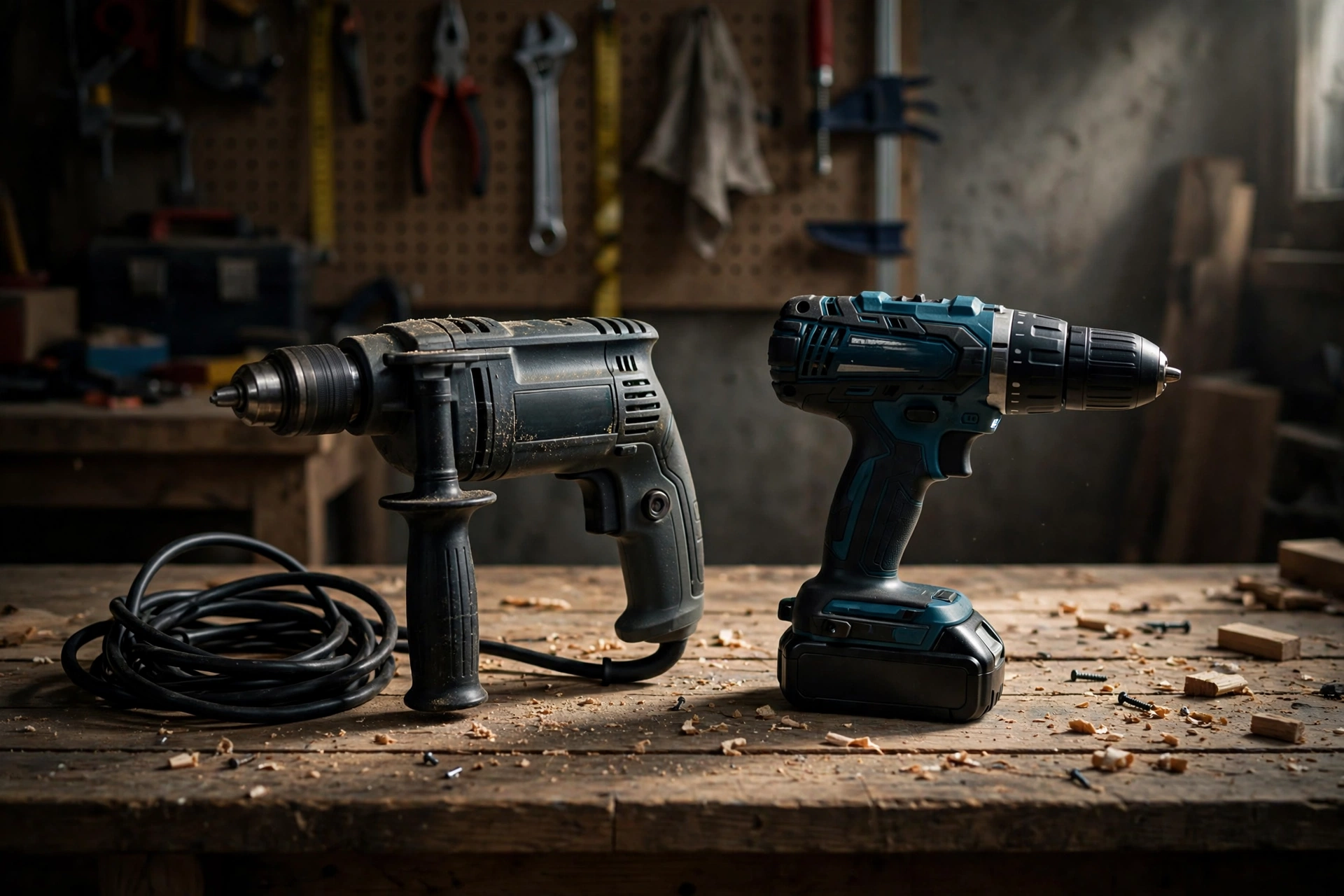
Quick answer
Go cordless for: drills, impact drivers, and most handheld tools you’ll carry around a jobsite or house. The convenience is transformative and the power gap has closed for these tools.
Stay corded for: tools that run continuously at high power — table saws, miter saws (for heavy use), routers doing long passes, angle grinders doing extended grinding, and shop dust collection. Also: anything where you hate battery anxiety.
The real answer for most people: a cordless drill + impact driver core, with corded specialty tools where sustained power matters. Hybrid is not a compromise — it’s the smart money.
Power: the gap closed, then didn’t, then closed again
Ten years ago, cordless was a toy compared to corded. Five years ago, brushless motors and high-output batteries closed the gap for most tools — a modern 18V/20V brushless drill genuinely matches a corded drill for normal work.
But physics still exists. Sustained high-draw tools — the ones pulling 1,000+ watts continuously — still favor the cord:
| Tool | Corded advantage? | Why |
|---|---|---|
| Drill / impact driver | No — cordless wins | Intermittent use; batteries handle it easily |
| Circular saw | Mostly no | Modern cordless saws cut fine; heavy ripping still favors corded |
| Angle grinder (grinding) | Yes | Continuous high load drains batteries fast; corded grinders run forever |
| Router (long passes) | Yes | Sustained load + heat; corded routers don’t fade mid-pass |
| Table saw | Yes | The highest-draw common tool; cordless versions exist but are compromises |
| Miter saw | Depends | Light trim work: cordless fine. All-day framing: corded |
| Sander | No | Low draw; cordless sanders are excellent now |
| Shop vac / dust collection | Yes | Runs for hours; batteries are pointless here |
The pattern: intermittent tools went cordless; continuous-duty tools stayed corded. A drill runs in bursts — perfect for batteries. A table saw runs for minutes at a time under load — that’s what wall current is for.
Cost: the math nobody shows you
Cordless looks affordable until you do the full math. Let’s be honest about it:
Corded: you buy the tool. That’s it. A $120 corded circular saw is $120, forever.
Cordless: you buy the tool ($100–$150 bare), then batteries ($60–$120 each for real ones, and you need at least two), then a charger ($40–$80 if not included). A “cheap” cordless tool quickly becomes a $250+ investment once it’s actually usable.
The trick the industry pulled: the battery platform lock-in. Once you own three DeWalt 20V batteries, your next five tool purchases will probably be DeWalt — not because they’re the best tool each time, but because the batteries are already paid for. That’s not a scam exactly — it’s genuinely convenient — but go in with your eyes open. Choosing the right battery platform is the highest-stakes decision in cordless buying.
Bare tools (no battery) are the smart buy once you’re on a platform — often 40–50% cheaper than kit prices. Never buy a second kit just for the tool; buy bare and share batteries.
Print This Before You Buy — The True Cost of Going Cordless
Cordless looks affordable until you add up everything it takes to actually use the tool. Run these numbers before you compare a cordless price tag with a corded one.
| What you pay for | Corded | Cordless |
|---|---|---|
| The tool itself | A $120 corded circular saw is $120, forever | $100–$150 bare (no battery, no charger) |
| Batteries | None — wall current is infinite and free at the point of use | $60–$120 each for real ones, and you need at least two |
| Charger | None | $40–$80 if not included in the kit |
| Real total to get working | $120 | $250+ for a “cheap” cordless tool once it is actually usable |
| Replacement cycle | None — a corded tool from 1995 still works today if the motor is fine | Batteries lose meaningful capacity after 3–5 years of regular use, even well cared for |
| Expanding your collection | Buy the tool, done | Buy bare tools once you are on a platform — often 40–50% cheaper than kit prices. Never buy a second kit just for the tool; buy bare and share batteries. |
| The lock-in catch | None | Once you own three batteries on one platform, your next five tool purchases will probably be that brand — not because each tool is best, but because the batteries are already paid for. Batteries are proprietary to each platform. |
The bottom line from this guide’s own math: all corded is cheaper upfront and over time; all cordless costs more but buys enormous convenience. The hybrid approach — cordless core tools, corded stationary and high-draw tools — is usually the best value.
Convenience: cordless wins and it’s not close
Let’s give credit where it’s due. Not dragging a cord around is transformative for:
- Working anywhere: yard, roof, attic, a friend’s house with no outdoor outlets
- Ladders: one hand for the tool, one for the ladder — no cord management
- Quick jobs: grab and go beats uncoiling, plugging, routing the cord safely
- Tight spaces: no cord snagging on everything
There’s also a subtle safety angle: no cord means no cord to accidentally cut (circular saws vs. their own cords is a classic), no tripping hazard across the workspace.
Winner for convenience: cordless, overwhelmingly.
Longevity: the corded tool’s quiet superpower
Here’s the argument nobody in marketing makes: a corded tool lasts decades; a cordless tool lasts as long as its batteries do.
Batteries degrade. Even well-cared-for lithium packs (stored properly) lose meaningful capacity after 3–5 years of regular use. And in 10 years, will the manufacturer still make your battery format? Probably — the big platforms have good track records — but “probably” isn’t “certainly,” and proprietary batteries are a single point of failure for every tool on the platform.
A corded tool from 1995 still works today if the motor’s fine. There’s no battery to obsolete it. For tools you use occasionally but want to keep forever — a corded angle grinder, a corded router — that’s real value.
Winner for longevity: corded.
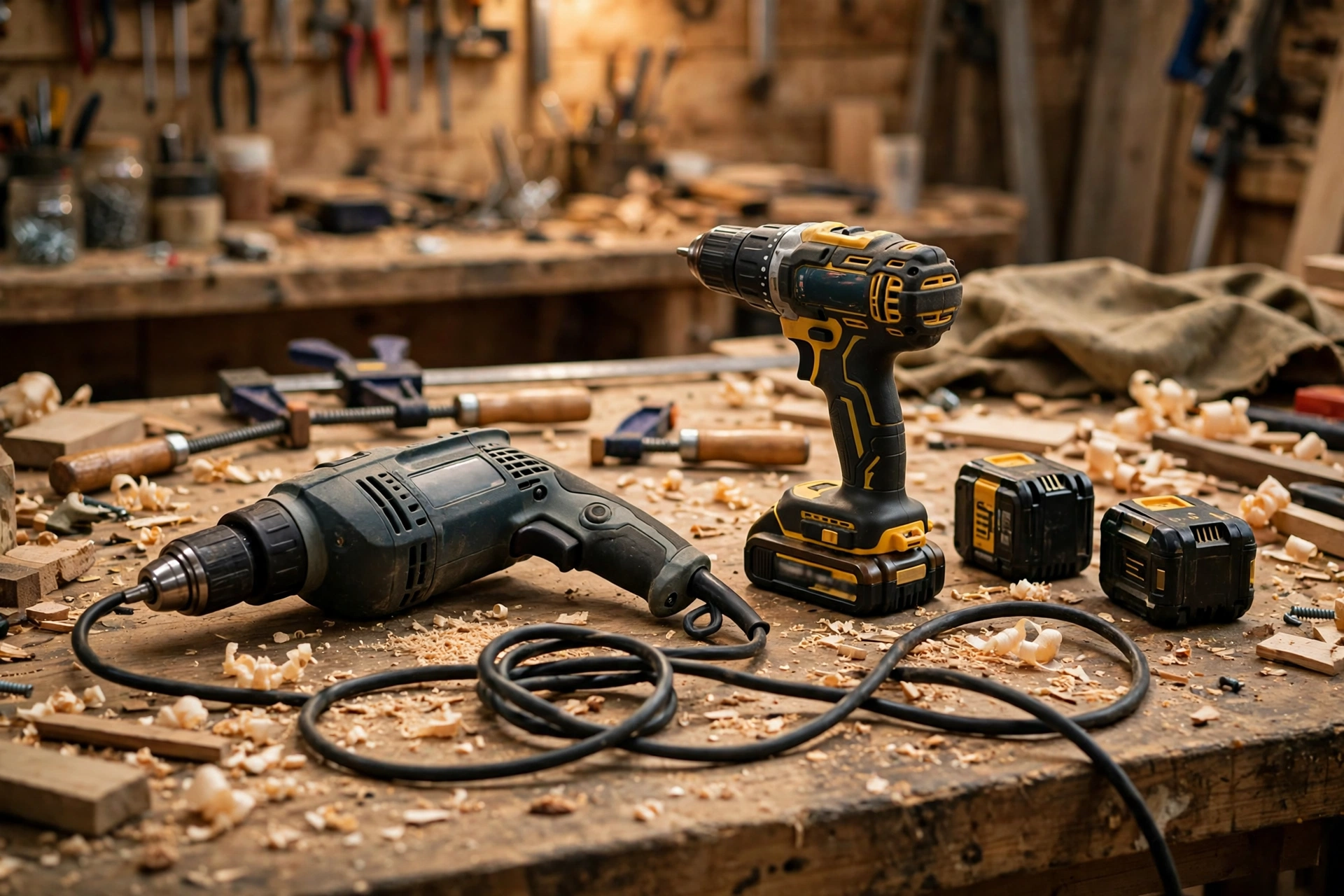
Weight and balance
Batteries are heavy. A cordless drill with a 5.0Ah pack weighs noticeably more than its corded equivalent, and the weight sits in exactly the wrong place (the handle base). For overhead work — drilling into ceilings, driving screws upward — that extra half-pound matters by the end of the day.
On the flip side, no cord dragging means the tool feels lighter in motion even when it weighs more on the scale. It’s a wash for most people, but if you do lots of overhead work, it’s worth handling both in the store.
Print This Before You Buy — The Cordless Platform Lock-In Checklist
The tool price is the smallest part of going cordless. Check these seven points before you commit to a battery platform — they are the expensive lessons from this guide, in one place.
- Batteries are proprietary to each platform — a battery from one brand does not power another brand’s tools.
- Budget for at least two real batteries ($60–$120 each) plus a charger ($40–$80 if not included) before calling any bare tool a bargain.
- Once you own three batteries on one platform, your next five tool purchases will probably be that brand — because the batteries are already paid for.
- Buy bare tools once you are on a platform — often 40–50% cheaper than kit prices; never buy a second kit just for the tool.
- Expect batteries to lose meaningful capacity after 3–5 years of regular use, even well cared for.
- Ask the 10-year question: will the manufacturer still make your battery format? Big platforms have good track records, but “probably” is not “certainly.”
- For occasional-use tools you want to keep for decades, consider corded — a corded tool has no battery format to go obsolete.
Keep This Chart Handy — Diagnose Your Job in 30 Seconds
Don’t overthink it — find your job below and the answer picks itself. Every row comes from the comparisons in this guide.
| Your job looks like this | Pick | Why, in one line |
|---|---|---|
| Drilling holes and driving screws all over the house, yard, or a friend’s place | Cordless | Intermittent bursts are exactly what batteries handle best |
| Grinding, routing, or sawing non-stop for an hour or more | Corded | Sustained 1,000+ W draw drains batteries fast; wall current never fades |
| Ripping boards on the table saw all afternoon | Corded | The highest-draw common shop tool — cordless versions are compromises |
| Working up a ladder, on the roof, or in the attic | Cordless | One hand for the tool, one for the ladder — no cord to manage or trip over |
| Drilling overhead into a ceiling all day | Handle both in the store first | A 5.0Ah pack adds roughly a half-pound (0.23 kg) in the worst possible spot |
| A tool you will use twice a year but want to keep forever | Corded | No battery format to go obsolete — a corded tool from 1995 still works today |
| Building your very first kit from zero | Cordless drill/driver kit | The most useful day-one tools; expand later with bare tools at 40–50% off kit prices |
What the pros actually do
Watch a real jobsite and you’ll see the hybrid approach in action: cordless drills and impacts on everyone’s hips (convenience wins for the most-used tools), but the miter saw station has a cord, the table saw has a cord, and the big grinder doing all-day work has a cord. Pros aren’t sentimental — they run whatever makes money fastest. The pattern is the answer.
What They Share — Keep This in Mind
After all that comparing, here’s the part nobody argues about — the truths that hold no matter which side of the extension cord you live on.
- Both cut only as well as their accessories. A dull blade or a chewed-up bit makes a $400 tool feel like a toy — corded or not.
- Both demand the same safety gear. Eye protection, hearing protection, dust mask. The plug type changes nothing about the physics of flying debris.
- Both have consumable costs. Corded tools eat brushes, belts, and cords; cordless tools eat batteries. Neither runs free forever.
- Both last for years on the same basics: clean the vents, store them dry, don’t drop them. The maintenance chapter doesn’t have a corded edition and a cordless edition.
- Both hold resale value the same way: working condition, included accessories, brand reputation. Buyers inspect those three before they ask what’s powering it.
A third path, if neither fits: if you already own a shop compressor, pneumatic tools deserve a look — unlimited runtime like corded, with the hose-handling habits of cordless. They’re a garage-shop answer, not a jobsite one, but for a home shop they split the difference surprisingly well.
Are cordless tools as powerful as corded in 2026?
For intermittent tools (drills, drivers, saws for normal cuts): yes, effectively. For sustained high-draw tools (table saws, heavy grinding, long router passes): no — corded still wins on sustained output.
Is it cheaper to go all cordless or all corded?
All corded is cheaper upfront and over time (no battery replacements). All cordless costs more but buys enormous convenience. The hybrid approach — cordless core tools, corded stationary/high-draw tools — is usually the best value.
How long do cordless batteries really last?
3–5 years of regular use before noticeable degradation, longer with proper storage and charging habits. Heavy daily professional use wears them faster.
Should a beginner start corded or cordless?
Cordless — specifically a drill/driver combo kit on a major platform. It’s the most useful starting point, and the platform gives you a cheap expansion path via bare tools. Add corded specialty tools later as needs arise.
Will cordless eventually replace everything?
Battery energy density keeps improving, but wall current is infinite and free at the point of use. For continuous-duty shop tools, corded will remain rational for a long time. Don’t wait for a future that may not come for your specific needs.
Can I use my cordless batteries across brands?
No — batteries are proprietary to each platform (with rare adapter exceptions that void warranties). This is exactly why platform choice matters so much.
Keep This Chart Handy — Your Situation, Your Pick
| Your situation | Go this way | Why |
|---|---|---|
| First tools ever | Cordless drill/driver kit on a major platform | Most useful day-one tools; bare-tool expansion keeps the platform cheap |
| Most-used handheld tools | Cordless | Convenience transforms daily use — the time savings are real |
| Table saw, heavy miter saw use | Corded | Sustained high-draw power with no battery fade mid-cut |
| Angle grinder for long grinding sessions | Corded | Continuous load drains batteries in minutes; the cord never fades |
| Occasional use, keep forever | Corded | No battery platform to go obsolete; lasts decades |
| Working everywhere (yard, roof, no outlets) | Cordless | No wall current needed — grab and go |
| Best overall strategy | Hybrid — cordless core, corded muscle | Each tool gets what it does best; convenience where you carry, power where you plug in |
The cordless revolution is real, but it’s not total. Buy cordless where convenience matters (your hands, every day), buy corded where physics matters (sustained power, decades of service). Anyone telling you it’s all-or-nothing is selling you something — probably batteries.
Keep Reading
Three more guides to sharpen your buying decisions:
- DeWalt 20V vs Milwaukee M18 Battery Platform — the highest-stakes decision in cordless buying (bookmark the comparison).
- How to Store Power Tool Batteries — get the full 3–5 years (and beyond) out of every pack.
- How to Clean and Maintain Power Tools — corded or cordless, maintenance is what makes them last decades.
Tool Worth Lab provides research-based buying guidance. Prices are approximate US street prices and vary by retailer and sales. Battery life claims vary with use; always check current specs before buying.