
Somewhere in your house right now there is a half-finished project staring at you — the shelf with one bracket, the garden bed that is still a pile of boards, the room you started “last spring” and now pretend not to see. It did not stall because you got lazy. It stalled because nobody told you the boring truth: projects do not die from hard work, they die from the five minutes of thinking you skipped before you started.
Here is the good news — that thinking takes about thirty minutes, a pen, and the five-phase sequence below. Do it once, properly, and the next project does not just get finished, it gets finished on budget, on time, and with you actually enjoying the build instead of firefighting it. Let us make “someday” happen this weekend.
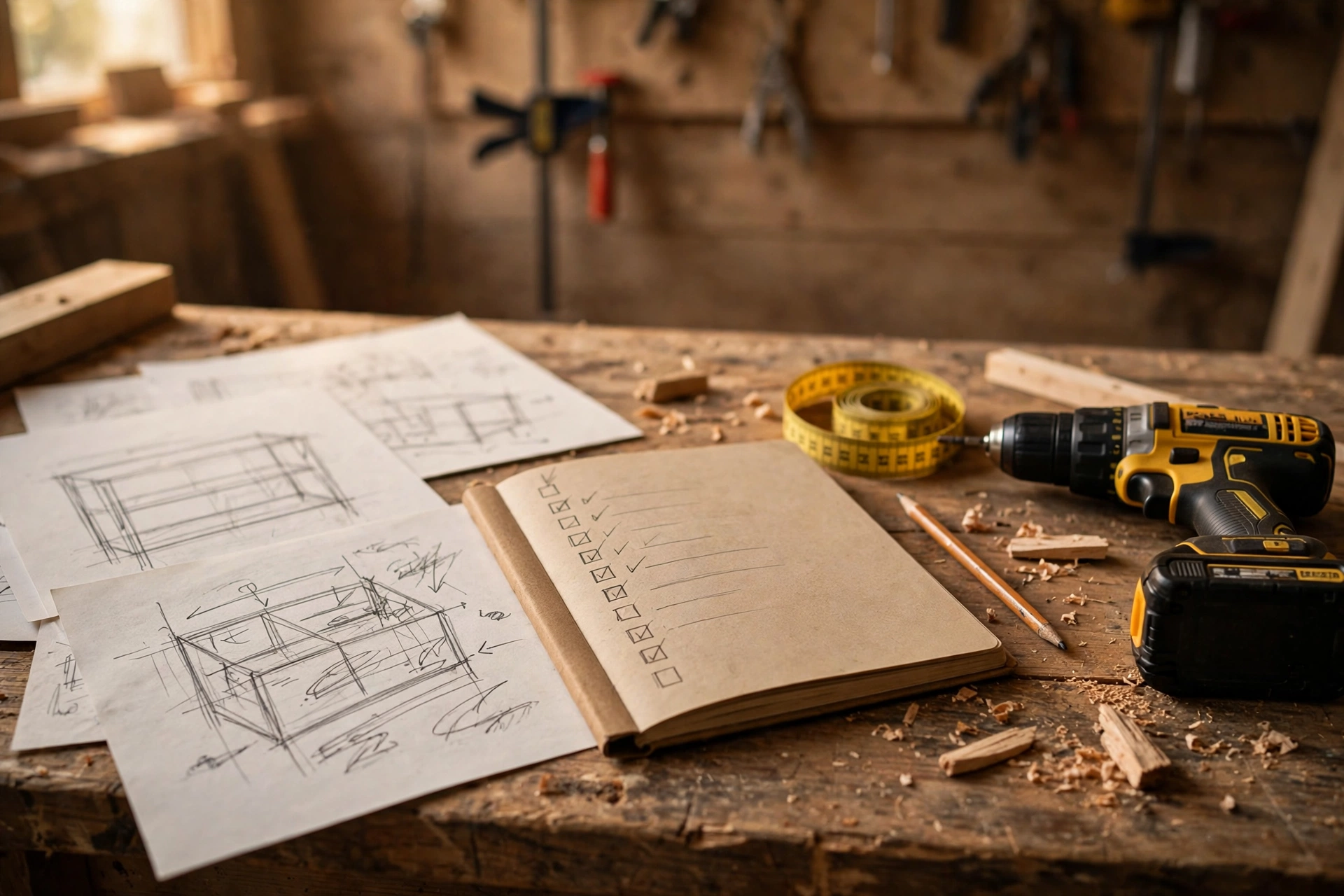
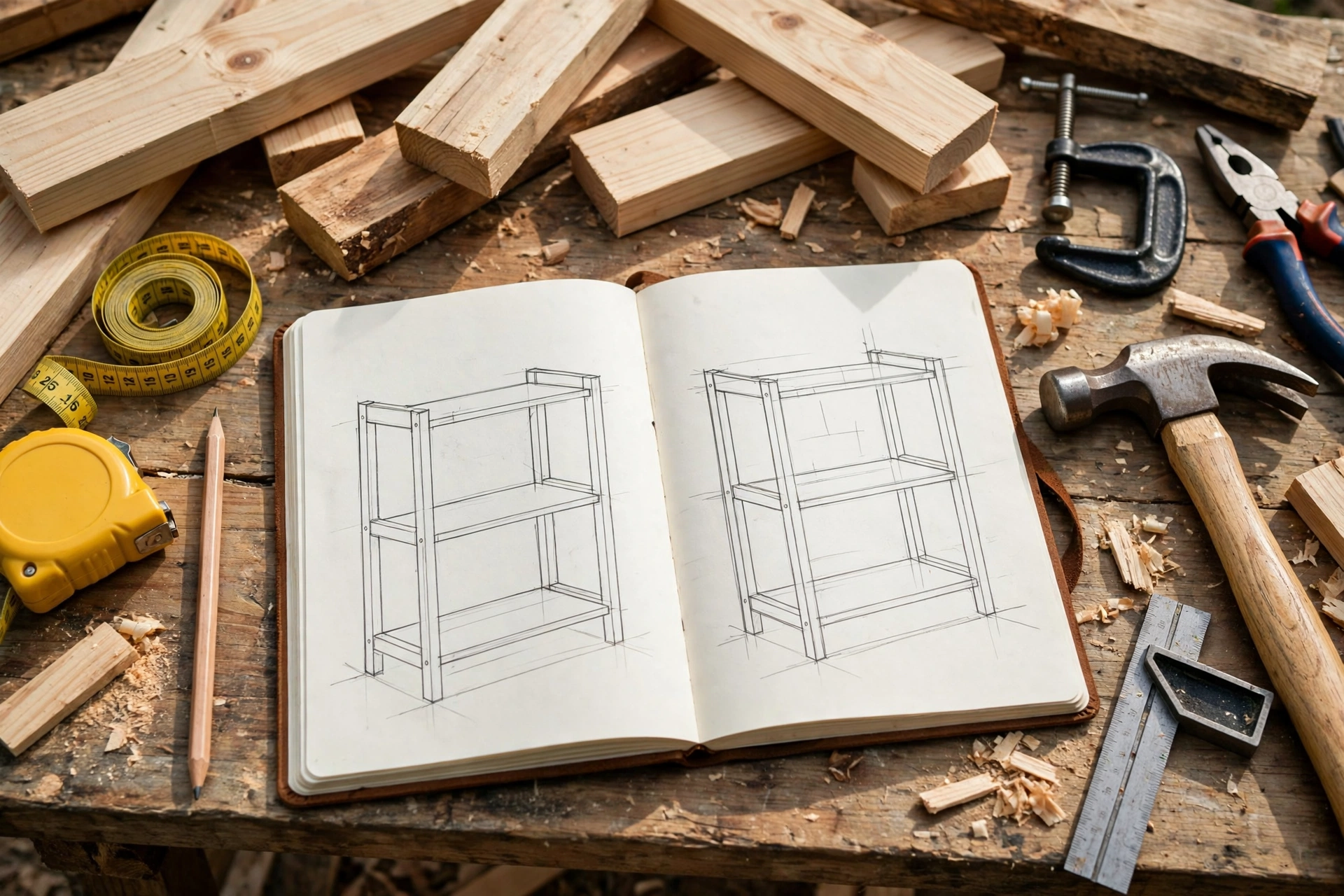
The fundamental truth: projects don’t fail during execution — they fail during planning (or the lack of it). The wrong materials ordered, the missing tool discovered mid-project, the permit never pulled, the budget blown on surprises. Planning converts chaos into sequence.
Phase 1: Define (what are you actually building?)
The scope statement
Write one paragraph: what, where, how big, to what standard.
- “Build a 4×8 ft cedar raised garden bed, 11″ deep, in the sunny south yard, to last 10+ years.”
- Not: “build a garden bed” (vague scopes produce vague results and surprise costs).
The specificity test: could someone else read your scope and buy the right materials? If not: it’s not specific enough.
The success criteria
What does “done” look like? What does “done well” look like?
- Functional requirements (it must hold soil, drain properly, last 10 years).
- Aesthetic requirements (it should look intentional, match the yard).
- The “good enough” line (perfection isn’t the goal — the defined standard is).
The constraint inventory
| Constraint | Questions to answer |
|---|---|
| Budget | Total limit? Per-phase limits? Contingency? |
| Time | Deadline? Available hours per week? Seasonal constraints? |
| Skill | What can you already do? What must you learn? What’s beyond you (hire)? |
| Space | Work area? Storage for materials? Access for deliveries? |
| Regulations | Permits? HOA? Setbacks? Code requirements? |
| Help | Solo or need a crew? For which phases? |
The honesty requirement: this phase demands brutal self-assessment. Overestimating skill, underestimating time, and ignoring regulations are the three planning failures that kill projects.
Phase 2: Research (learn before you buy)
The 3-source rule
For any technique you haven’t done before: consult three sources (not one YouTube video).
- Our guides (the full library) — the structured reference.
- Manufacturer instructions (for products — they know their product).
- Community experience (forums, local experts — the practical gotchas).
Why three: single sources have blind spots; three sources reveal the consensus (and the disagreements worth investigating).
The material list
Build the complete material list BEFORE shopping:
- Every board, every fastener, every bag of concrete — quantified.
- Add 10–15% overage (cuts, mistakes, defects — the waste factor is real).
- Note the specifications (not “wood screws” but “3” exterior-coated #8 wood screws”).
The material list is the budget. Until it’s complete, you don’t know the cost.
The tool inventory
| Category | Action |
|---|---|
| Own | Verify condition (sharp? working? calibrated?) |
| Need to buy | Add to budget (using the buying framework) |
| Borrow | Confirm availability for the specific dates |
| Rent | Price it, reserve it (rent vs buy logic) |
The mid-project tool run is the classic planning failure — discovering you need a tool on Saturday afternoon when stores close at 6. The inventory prevents it.
Phase 3: Budget (the real numbers)
The budget structure
| Line item | Typical % |
|---|---|
| Materials | 50–70% |
| Tools (new) | 10–20% |
| Rentals | 5–10% |
| Permits/fees | 0–10% |
| Contingency | 15–20% |
| Professional help | 0–30% (if applicable) |
The contingency (non-negotiable)
15–20% contingency on every project. Not “if needed” — always. The contingency covers: – Price changes (lumber fluctuates). – Mistakes (miscuts, broken materials). – Discoveries (rot behind the wall, bad soil, wrong measurements). – Scope creep (the “while we’re at it” additions).
Projects without contingency don’t go over budget — they go unfinished. The contingency is what lets you finish when reality differs from the plan.
The go/no-go decision
Total the budget. Add contingency. Compare to your limit.
- Under budget: proceed.
- Over budget: redesign, downscale, or delay — not “hope it works out.” Hope isn’t a budget strategy.
- The honest no-go is better than the optimistic start-and-stall (half-finished projects cost more than unstarted ones).
Print This Before You Buy Anything — Pre-Purchase Checklist
Run through this list before a single dollar leaves your wallet. If any box is unchecked, you are not ready to shop yet — and that is exactly the moment this list earns its keep.
- Scope passes the specificity test — one paragraph stating what, where, how big, and to what standard, specific enough that someone else could read it and buy the right materials.
- Three sources consulted for every unfamiliar technique — a structured guide, the manufacturer instructions for the products involved, and community experience for the practical gotchas.
- Material list complete, quantified, and specified — every board, fastener, and bag of concrete listed with quantities, exact specifications (not “wood screws” but “3 in / 76 mm exterior-coated #8 wood screws”), plus 10–15% overage for cuts, mistakes, and defects.
- Tool inventory confirmed for the dates needed — every tool marked as own (condition verified: sharp, working, calibrated), buy (added to the budget), borrow (availability confirmed for the specific dates), or rent (priced and reserved).
- Budget totaled with a 15–20% contingency — the buffer covers price changes, miscuts, discoveries behind walls, and “while we are at it” scope creep. A budget without it is a fantasy.
- Go/no-go decision passed explicitly — total compared against the limit. Under budget: proceed. Over budget: redesign, downscale, or delay — never “hope it works out.”
- Constraints checked — permits, HOA rules, setbacks, and code requirements answered, plus help lined up for the phases you cannot do solo.
Phase 4: Sequence (the order of operations)
The dependency map
List every task. For each: what must be done before this can start?
Example (deck): 1. Permits → 2. Layout → 3. Footings → 4. Posts → 5. Beams → 6. Joists → 7. Decking → 8. Railings → 9. Stairs.
The critical path is the longest dependency chain — it determines the minimum timeline. Everything else schedules around it.
The phase gates
Natural stopping points where you verify before proceeding:
- Foundation phase: is it level? square? (Everything above inherits these.)
- Framing phase: is it plumb? braced? (The structure’s integrity.)
- Finish phase: is the prep complete? (Finishes reveal prep flaws.)
Never skip a phase gate. The 10 minutes of verification prevents the hours of rework.
The timeline
- Estimate each task (then double it — the planning fallacy is universal; everything takes longer than estimated).
- Account for: drying/curing times (concrete, paint, caulk), delivery lead times, helper availability, weather windows.
- Seasonal reality: exterior projects need weather windows; concrete needs temperature; paint needs dry conditions.
Phase 5: Execute (the planned work)
The daily prep
Each work session: 1. Review today’s tasks (from the sequence). 2. Stage materials and tools (before starting — not during). 3. Safety check (PPE, tool condition — the safety guide). 4. Work the plan.
The adaptation rule
Plans change; principles don’t. When reality differs: – Assess (what changed?). – Adapt (what’s the new best path?). – Document (update the plan — don’t carry changes in your head). – Continue (don’t freeze — imperfect progress beats perfect paralysis).
The documentation habit
- Photos at each phase (progress + evidence for future troubleshooting).
- Notes on what worked and what didn’t (the learning compounds).
- Receipts filed (warranty claims, tax records, future reference).
The 7 planning mistakes (and how to avoid them)
- No written scope — “I’ll figure it out as I go” (the most expensive sentence in DIY).
- No contingency — the budget without a buffer is a fantasy.
- Skipping permits — the fine + teardown + rebuild costs more than the permit ever did.
- Wrong sequence — painting before caulking, finishing before the structure is verified.
- No tool inventory — the Saturday-afternoon emergency run.
- Unrealistic timeline — the planning fallacy (double your estimates).
- No phase gates — discovering the foundation isn’t level after the walls are up.
Stalled Project Rescue Chart — Keep This Handy
Already stuck halfway through a project? Do not start over — diagnose it. Find your symptom below, fix the cause, and get moving again. This works on anything from a 4 × 8 ft (1.2 × 2.4 m) garden bed to a full room remodel.
| Symptom | Likely cause | The fix |
|---|---|---|
| Half-finished for weeks, nobody wants to touch it | Scope was never written down — “I will figure it out as I go” | Write the one-paragraph scope (what, where, how big, to what standard) before another hour of work. |
| Money ran out with work still to do | No contingency in the budget | Stop, re-total the budget with a 15–20% contingency, and make the go/no-go call — redesign, downscale, or delay beats stalling. |
| Waiting on a tool, a delivery, or a permit | No tool inventory, no dependency map | List what each remaining task depends on, order or reserve it now, and work the tasks that are not blocked. |
| Work done in the wrong order | No sequence plan — finishing before the structure is verified | Map the dependencies, respect the phase gates, and verify before the next phase starts. |
| Everything takes twice as long as planned | Estimates were never doubled for first-time techniques | Re-estimate honestly, double first-time techniques, and run the 30-minute weekly review to catch drift early. |
| Scope keeps growing — “while we are at it…” | Scope creep with no success criteria | Re-read the success criteria and the “good enough” line; anything beyond it goes on a separate project list. |
The project planner template
“` PROJECT: _______________ SCOPE: _______________ SUCCESS CRITERIA: _______________
CONSTRAINTS: – Budget: $_____ (contingency: $_____) – Timeline: _____ to _____ – Skill gaps to learn: _______________ – Permits needed: _______________ – Help needed (who/when): _______________
MATERIALS: (complete list with quantities + 10-15% overage) 1. _______________ 2. _______________ …
TOOLS: – Own (verified): _______________ – Buy: _______________ – Borrow (confirmed): _______________ – Rent (reserved): _______________
SEQUENCE: 1. _____ (depends on: _____) 2. _____ (depends on: _____) …
PHASE GATES: – [ ] Gate 1: _____ verified – [ ] Gate 2: _____ verified
GO/NO-GO: Budget $_____ vs limit $_____ → _____ “`
Copy this. Fill it in. Every project. The 30 minutes of planning saves the 30 hours of chaos.
Don’t Start the Next Phase Until This Passes — Bookmark This Checklist
| Phase gate | Check before moving on |
|---|---|
| Define gate | The scope is one specific paragraph — what, where, how big, to what standard — and it passes the specificity test: someone else could read it and buy the right materials. |
| Research gate | Three sources consulted for any unfamiliar technique, the material list is complete, and the tool inventory is done — own, buy, borrow, or rent confirmed for the dates needed. |
| Budget gate | The budget carries a 15–20% contingency and has passed an explicit go/no-go decision against the total limit. |
| Sequence gate | Dependencies are mapped, phase gates are set, and the timeline is realistic — double the estimate for any technique tried for the first time. |
| Execute gate | Daily preparation is done, the adaptation rule is agreed (stop, assess, adapt, continue), and progress is documented as the work goes. |
| Weekly gate | A 30-minute review happens at the same time every week, answering four questions: what got done versus the plan, what the next bottleneck is, what was spent versus the budget, and what is waiting on someone else. |
The 30-minute weekly review that saves projects
Most DIY projects do not fail on day one. They fail in week three, quietly, when a small delay compounds into a stalled project and a half-finished room. The antidote is a weekly review, thirty minutes, same time every week, no exceptions.
Ask four questions. First: what actually got done this week versus what the plan said? If the gap is more than one task, the plan — not your work ethic — needs adjusting. Second: what is the next bottleneck? Order the material, book the helper, or reserve the tool now, before it becomes the reason next week stalls. Third: what did you spend versus the budget, including the small trips to the hardware store that never make it into the spreadsheet? Those twenty-dollar runs are where budgets bleed out. Fourth: is anything waiting on someone else — a permit, a delivery, a contractor callback? Chase it now; other people’s timelines never speed up on their own.
Write the answers down, one page, and pin it where you work. Projects with a weekly review finish; projects without one drift. The review is not bureaucracy — it is the cheapest insurance a project can have, and it turns a vague “someday” finish into a date you can defend.
How much planning is enough?
Until you can answer: what exactly am I building, what does it cost (with contingency), what tools do I need (all of them), what’s the sequence, and what’s the timeline. If any answer is “I’ll figure it out” — keep planning.
Should I plan differently for my first project vs my tenth?
First projects need MORE planning (you don’t know what you don’t know — the research phase is longer). Experienced builders plan faster but still plan (the template takes 30 minutes regardless of experience).
What if I discover a problem mid-project?
That’s what contingency (budget) and adaptation (sequence) are for. Stop, assess, adapt the plan, use the contingency if needed, continue. Problems aren’t planning failures — they’re why you planned (the buffer exists for exactly this).
How do I estimate time for something I’ve never done?
Ask someone who has (the best estimate), consult multiple sources (the 3-source rule), then double it (the planning fallacy correction). Your first attempt at any technique takes 2–3x longer than an experienced person’s — that’s normal, not failure.
When should I hire instead of DIY?
When: the skill gap is dangerous (electrical panels, gas, structural), the tools cost more than the pro (specialized one-time), the timeline is critical (pros are faster), or permits require licensing. The 25 skills guide marks the DIY zone; beyond it, the pro’s insurance and expertise earn their fee.
Is this overkill for small projects?
Scale the planning to the project — a showerhead replacement needs 5 minutes of thought; a shed needs the full template. The framework scales; the principle (think before doing) doesn’t change.
The verdict: the universal planning sequence
Define (scope + constraints) → Research (3 sources + material/tool lists) → Budget (with 15–20% contingency + go/no-go) → Sequence (dependencies + phase gates + realistic timeline) → Execute (daily prep + adaptation + documentation).
Five phases, applicable to every project from a birdhouse to a house addition. The guides teach you HOW to do everything; this one teaches you how to ensure you actually FINISH.
That’s the DIY wisdom in one framework. The techniques are the vocabulary; planning is the grammar. And grammar is what turns words into sentences — plans into finished projects.
Tool Worth Lab provides research-based DIY guidance. Always define scope before buying materials, budget 15–20% contingency (non-negotiable), verify permits before starting, double your time estimates (planning fallacy), and know when the project belongs to a licensed professional (gas, main electrical, structural).