
Quick quiz: what is the most powerful tool in your house that you only ever use for one job? If your answer is “the heat gun I bought to strip paint years ago,” congratulations — you have been parking a superhero in a drawer. That unassuming little gun blows air hotter than 1,000°F (540°C), and it can thaw a frozen pipe in the middle of winter, light a barbecue without lighter fluid, bend a PVC pipe around a corner, and peel a decade-old bumper sticker clean off.
The catch — and it is a big one — is that the same superpower melts, scorches, and burns just as fast as it fixes. The difference between “fixed it” and “melted it” is the setting, the distance, and knowing which jobs to never, ever point it at. Here are the ten jobs where a heat gun genuinely earns its keep — and the rules that keep it from earning you a trip back to the hardware store for a replacement workpiece.
Safety first: Heat guns are deceptively dangerous — the air stream can exceed 1,000°F, hot enough to ignite wood, melt plastic instantly, and cause severe burns. Never point at skin, keep away from flammables, let the nozzle cool before setting it down (use the built-in stand), and work in ventilated areas — heating old paint may release lead fumes (test pre-1978 paint first).
Bookmark This Checklist — The 60-Second Heat Gun Pre-Flight Check
Run this list before you squeeze the trigger. Sixty seconds here saves the workpiece, the tool, and possibly your skin.
- Nozzle and intake clear? Blow out dust and debris. A persistent burning smell in an old gun can mean an obstruction or a failing element — if it persists, replace the gun.
- Built-in stand in place? Never set a hot gun down without it — the nozzle stays dangerously hot after switch-off, and a gun without a stand rolls and melts things.
- Ventilation sorted? Work in ventilated areas — heating old paint may release lead fumes.
- Old paint tested? Test pre-1978 paint for lead first. Heating lead paint above about 700°F (370°C) vaporizes lead, which is highly toxic — use low settings, a P100 respirator (not a dust mask), and ventilation.
- Penetrating oil evaporated? Let it evaporate fully before heating a stuck bolt — it is flammable.
- Gloves on for plastic work? Hot plastic sticks to skin and burns. Wear gloves when bending PVC, acrylic, or vinyl.
- Fire extinguisher within reach? Keep one accessible for stripping work, and never walk away from a hot gun.
- Distance set? Start 4–6 in (10–15 cm) away and move closer only as needed. Closer means hotter and faster — but also easier to scorch, melt, or ignite.
- Flammables moved away? Keep the gun away from flammables, and never point it at skin, hair, or clothing — even “just to test it.”
The golden rule behind every item above: keep the gun moving, always. A parked gun scorches, bubbles, or ignites — wood ignites around 450–500°F (230–260°C), and the gun blows past that easily.
The 10 uses
1. Shrink tubing and shrink wrap (the pro’s reason)
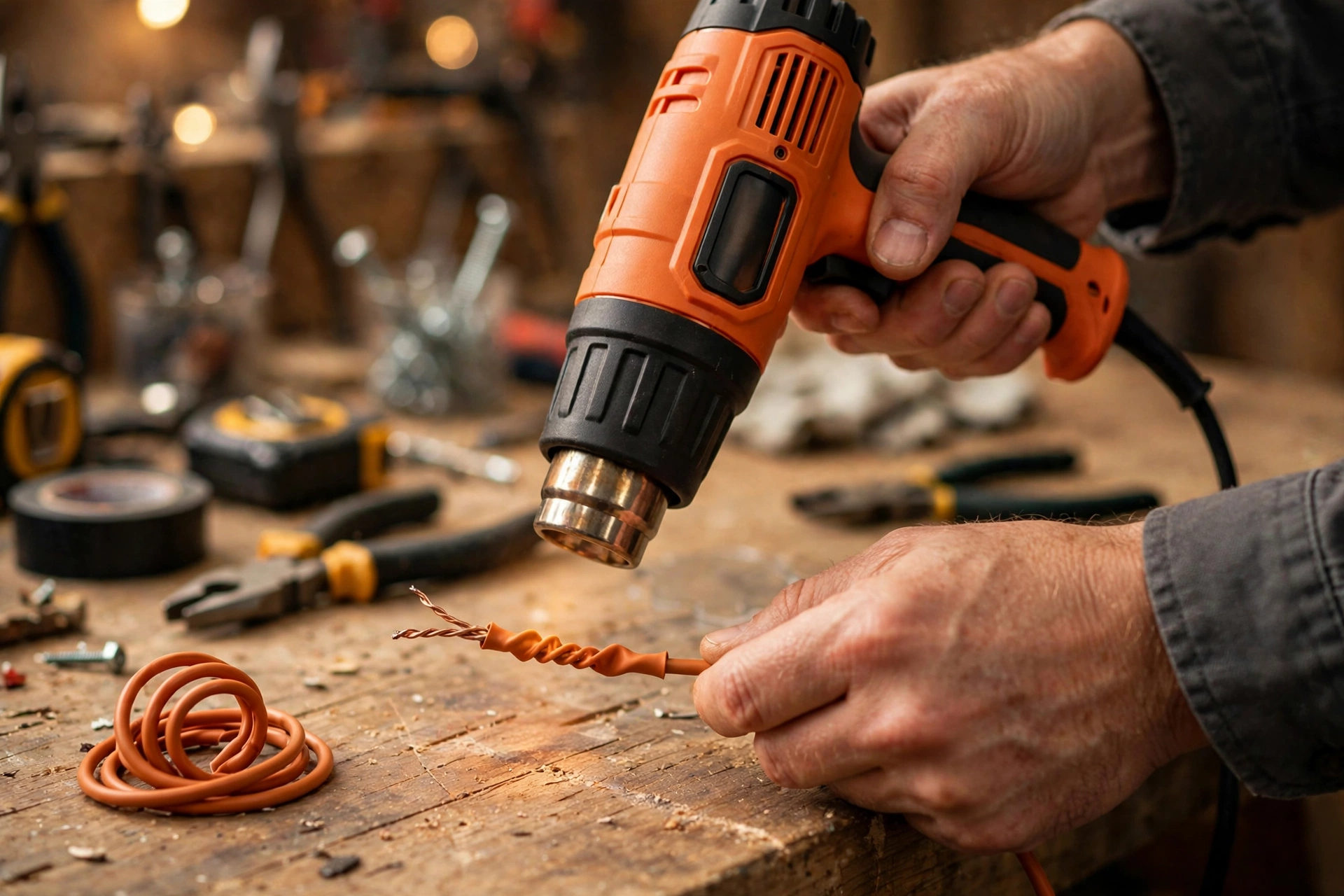
The #1 use professionals buy heat guns for: shrinking heat-shrink tubing over wire splices and connectors. A lighter works, but it chars the tubing and heats unevenly; a heat gun shrinks it smoothly and professionally in seconds. If you do any automotive, marine, or electronics wiring, this alone justifies the tool. Same principle for shrink-wrapping anything — bundling, protection, packaging.
2. Thawing frozen pipes (carefully)
A frozen pipe is a burst pipe waiting to happen. A heat gun on a low/medium setting, moved constantly along the pipe, thaws it far faster and more safely than a hair dryer — and far more safely than the torch some people disastrously reach for. Critical rules: keep it moving (never concentrate heat in one spot), start from the faucet end working back toward the freeze, and never use it on plastic (PVC/CPVC) pipes — you’ll melt them. For plastic pipes, warm towels are the safe option.
3. Removing stickers, decals, and labels
Heat softens adhesive like nothing else. Warm a bumper sticker, price label, or old decal for 20–30 seconds and it peels off cleanly instead of tearing into a hundred gummy fragments. Follow with a little adhesive remover for any residue. This works on glass, metal, painted surfaces (careful with heat on paint), and most plastics (low heat, test first).
4. Bending and shaping plastic (PVC, acrylic, vinyl)
Thermoplastics soften beautifully under a heat gun: PVC pipe bends for custom plumbing runs, acrylic sheets form into shapes, vinyl trim conforms to curves. Heat evenly, bend slowly, hold until cool. This is a genuine fabrication capability — custom brackets, guards, and fittings from flat stock. Wear gloves; hot plastic sticks to skin and burns.
5. Drying and curing (paint, filler, glue)
Need that second coat now? Gentle heat accelerates drying of paint, wood filler, and adhesives dramatically. Keep the gun moving at a distance — you’re warming, not cooking. Too close and paint bubbles, filler cracks, glue skins over uncured underneath. Low setting, constant motion, patience. Particularly useful in cold or humid conditions where drying stalls.
6. Loosening rusted and stuck fasteners
Heat expands metal — a stuck bolt heated for a minute often breaks free where penetrating oil and leverage failed. The heat breaks the corrosion bond and the differential expansion (bolt vs. surrounding material) does the work. This is the poor man’s induction heater and it genuinely works. Let it cool before touching, obviously, and keep flammables (penetrating oil is flammable — let it evaporate first) away.
7. Removing old caulk and adhesive
Like stickers at larger scale: heat softens old caulk, construction adhesive, and flooring glue, making mechanical removal dramatically easier. Warm a section, scrape, repeat. For bathtub caulk replacement or flooring tear-out, this turns a miserable job into a manageable one. Pair with an oscillating multi-tool scraper for maximum effect.
8. Window tint and vinyl wrap work
Applying or removing window tint, vinyl wraps, and protective films requires controlled heat to conform the material to curves and to release adhesive cleanly. The heat gun is the standard tool — too little heat and the vinyl won’t stretch; too much and it distorts. Practice on scrap; the technique matters more than the tool.
9. Lighting charcoal and campfires (yes, really)
A heat gun pointed at charcoal or kindling lights it in a minute or two — faster than chimney starters, no lighter fluid taste. It’s the fastest fire-lighting method short of a torch. Outdoor use only, obviously, and keep the gun itself away from the flames once things catch.
10. Electronics repair (soldering-adjacent work)
Low heat loosens adhesive-bonded phone screens and components; focused heat reflows suspect solder joints (the infamous “bake your graphics card” trick is a heat gun’s cruder cousin). This is advanced territory — too much heat destroys components — but for the repair-minded, a heat gun with a fine nozzle is a legitimate electronics tool. Temperature control matters enormously here; get a gun with digital temperature adjustment if this is your goal.
Which heat gun should you buy?
The good news: heat guns are simple, and even cheap ones work. The differences that matter:
- Variable temperature — essential. Single-temperature guns are blunt instruments; you want low (~200–400°F) for delicate work and high (1,000°F+) for stripping. Digital temperature control is worth the premium if you’ll do varied work.
- Multiple fan speeds — more control over heat delivery.
- Built-in stand — hands-free cooling and stationary work. Non-negotiable; a gun without a stand rolls and melts things.
- Nozzle attachments — concentrator nozzles (focused heat) and spreader nozzles (wide area) multiply versatility.
Price reality: $25–$40 buys a perfectly good variable-temp heat gun for general DIY. $80–$150 buys digital control, better ergonomics, and durability for regular use. The cheap ones aren’t bad — they’re just less precise. For most homeowners, the $30 class is completely adequate.
Keep This Chart Handy — Which Heat Gun Should YOU Buy?
Two price tiers, two power options — match your row and stop second-guessing in the store aisle.
| If you… | Buy this | Why it fits |
|---|---|---|
| Just want a capable all-rounder for general DIY | Variable-temperature heat gun, $25–$40 | Perfectly good for every job in this guide — shrink tubing, stickers, thawing, drying — and the price leaves room for the rest of the toolkit. |
| Want precise control and a tool that lasts | Digital-control model, $80–$150 | Buys you digital temperature control, better ergonomics, and durability for frequent or heavy use. |
| Do long, sustained jobs like paint stripping or pipe thawing | Corded model | Unlimited run time — heating elements are power-hungry, so a cordless gun drains batteries shockingly fast on sustained work. |
| Only need short bursts away from an outlet | Cordless model | Fine for quick jobs, but expect short battery life — it is not the pick for stripping or thawing sessions. |
| Are buying your first (or only) heat gun | Variable-temperature model with a built-in stand | The stand is a safety essential, not a luxury — it holds the hot nozzle safely while it cools instead of scorching whatever it touches. |
Bookmark This Chart — Heat Gun by Task — Keep This Handy
Screenshot this before your next project. The right setting is the difference between “fixed it” and “melted it.”
| Task | Setting | Pro tip |
|---|---|---|
| Shrink tubing & wrap | Low (~200–400°F / 95–205°C) | A lighter chars the tubing — the gun shrinks it smooth and professional in seconds. Start 4–6 inches away, keep it moving. |
| Thawing frozen pipes | Low/medium, constant motion | Start at the faucet end, work back toward the freeze. Never on plastic (PVC/CPVC) pipes — you’ll melt them. |
| Removing stickers & decals | Medium, 20–30 seconds | Peel while warm; follow with adhesive remover for residue. Low heat on plastics — test first. |
| Bending PVC, acrylic, vinyl | Medium, even heat | Heat evenly, bend slowly, hold until cool. Wear gloves — hot plastic sticks to skin and burns. |
| Drying paint, filler, glue | Low, at a distance | You’re warming, not cooking — keep the gun moving. Too close and paint bubbles, filler cracks. |
| Loosening stuck bolts | High, about 1 minute | Heat breaks the corrosion bond so leverage can finish the job. Let any penetrating oil evaporate first — it’s flammable. |
| Removing old caulk & adhesive | Medium | Warm a section, scrape, repeat. Pair with an oscillating multi-tool scraper for maximum effect. |
| Window tint & vinyl wrap | Medium, careful | Too little heat and the vinyl won’t stretch; too much and it distorts. Practice on scrap — technique beats the tool. |
| Lighting charcoal | High | Fastest fire-lighting method short of a torch — a minute or two, no lighter-fluid taste. Outdoor use only. |
| Electronics repair | Low, fine nozzle | Advanced territory — too much heat destroys components. Digital temperature control is worth it here. |
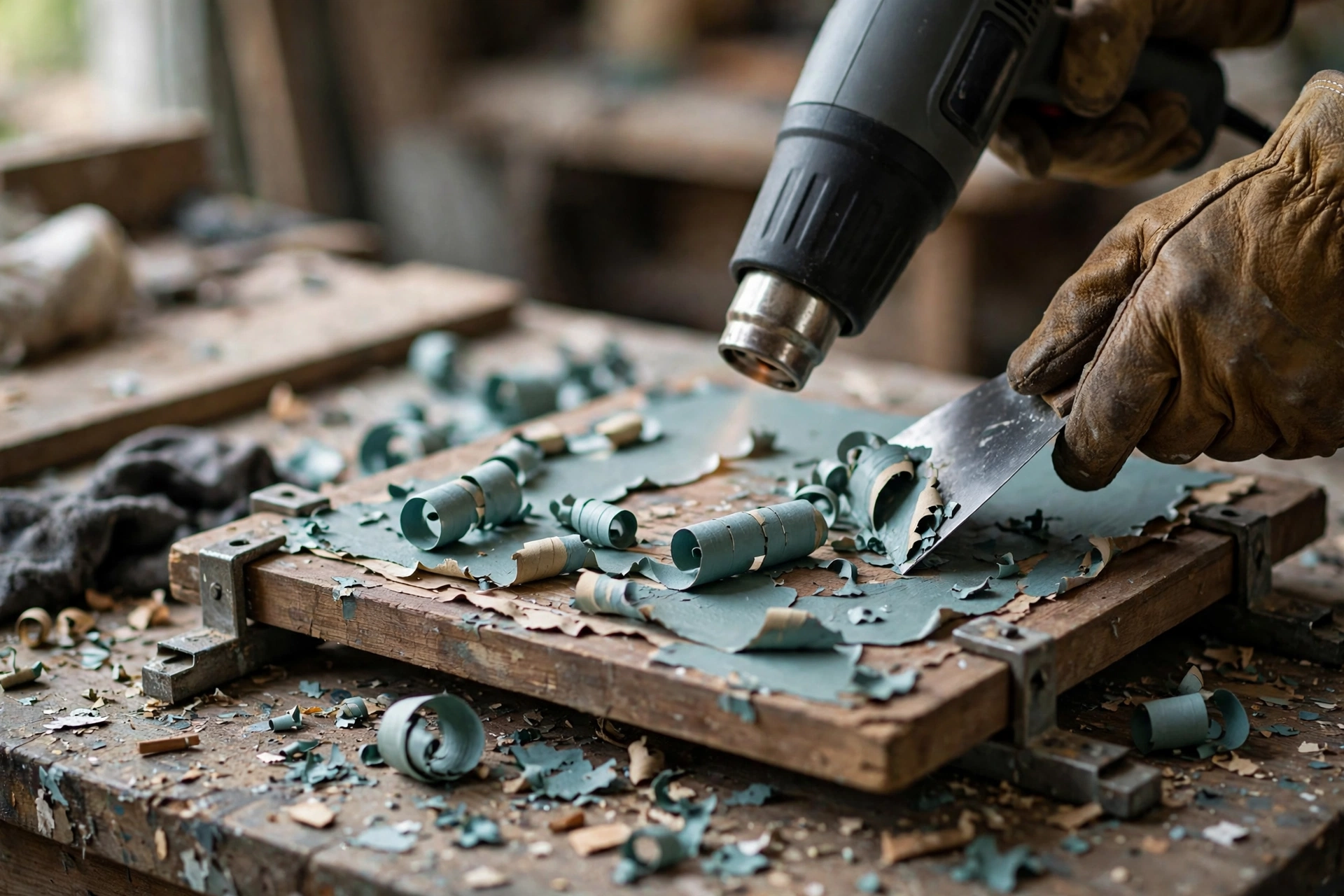
Print This Before You Squeeze the Trigger — What Your Heat Gun Must NEVER Touch
Tape this next to the heat gun. Every row below is a real way people damage the workpiece, the tool, or themselves — and every one is avoidable before you pull the trigger.
| Never point it at | Why not | Do this instead |
|---|---|---|
| Skin, hair, or clothing | Air past 1,000°F (540°C) causes severe burns in a second | Never point it at yourself or anyone else, even “just to test it” |
| Plastic (PVC/CPVC) pipes | A frozen plastic pipe melts under the gun | Warm towels are the safe option for plastic pipes |
| Old paint you have not tested | Heating lead paint above ~700°F (370°C) vaporizes lead, which is highly toxic | Test pre-1978 paint first; use low settings, a P100 respirator, and ventilation |
| A bolt still wet with penetrating oil | Penetrating oil is flammable | Let the oil evaporate fully before applying any heat |
| Wood, held still in one spot | Wood ignites around 450–500°F (230–260°C) | Keep the gun moving, always — a parked gun scorches, bubbles, or ignites |
| A hot gun left alone | The nozzle stays dangerously hot after switch-off | Use the built-in stand, let it cool, and never walk away from a hot gun |
Bookmark This Checklist — 7 Heat Gun Mistakes That Melt, Burn, or Ruin the Job
Tape this to the wall next to the heat gun. Every item below is a real way people damage the workpiece, the tool, or themselves.
- Pointing it at skin, or setting a hot gun down without the stand. The air stream can exceed 1,000°F (540°C) — hot enough to ignite wood and melt plastic instantly. Give the nozzle time to cool before putting it down, and always use the built-in stand.
- Holding still in one spot. On a frozen pipe, on paint, on wood — a parked heat gun scorches, bubbles, or ignites. Keep it moving, always. Wood ignites around 450–500°F (230–260°C), and the gun blows past that easily.
- Using it on plastic (PVC/CPVC) pipes. A frozen plastic pipe will melt under the gun. Warm towels are the safe option for plastic pipes.
- Heating old paint without checking for lead. Heating lead paint above about 700°F (370°C) vaporizes lead, which is highly toxic. Test pre-1978 paint first, use low settings, wear a proper respirator (P100, not a dust mask), and work in ventilated areas.
- Heating a bolt that is still wet with penetrating oil. Penetrating oil is flammable — let it evaporate fully before applying heat to a stuck fastener.
- Using it as a hair dryer. A hair dryer tops out around 140°F (60°C); a heat gun goes past 1,000°F (540°C). That is a burn waiting to happen.
- Leaving a hot gun unattended. Never walk away from a hot gun, and keep a fire extinguisher accessible for stripping work.
Keep Reading
Can a heat gun replace a hair dryer for these jobs?
For light tasks (stickers, shrink tube), a hair dryer on high sometimes works — but it tops out around 140°F vs the heat gun’s 1,000°F+. Anything needing real heat (paint stripping, bending plastic, thawing pipes) needs the gun. Don’t use a heat gun as a hair dryer, though — that’s a burn waiting to happen.
Is it safe to use a heat gun on wood?
For paint stripping, yes — with care and constant motion. Wood ignites around 450–500°F and heat guns exceed that easily. Keep moving, don’t linger, and have water nearby for stripping work. Scorching is the warning sign you’re too slow or too close.
Can I strip lead paint with a heat gun?
With extreme caution: heating lead paint above ~700°F vaporizes lead, which is highly toxic. Use low settings (below vaporization temp), wear a proper respirator (P100, not a dust mask), contain the area, and check local regulations — some jurisdictions restrict it. When in doubt, hire a certified lead abatement professional.
Why does my heat gun smell like burning?
New guns often smell on first use (manufacturing oils burning off) — normal, ventilate and continue. A persistent burning smell in an old gun can mean dust/debris inside the nozzle or a failing element. Blow out the intake, check for obstructions, and if it persists, replace the gun — they’re cheap enough that repair isn’t worthwhile.
Corded or cordless heat gun?
Corded for sustained work (stripping, thawing) — cordless heat guns drain batteries shockingly fast because heating elements are power-hungry. Cordless makes sense only for quick, portable tasks (shrink tubing in the field). For most buyers, corded is the right call.
How close should I hold it?
Start at 4–6 inches and move closer only as needed. Closer = hotter = faster, but also = easier to scorch, melt, or ignite. Let the work tell you: if nothing’s happening in 30 seconds, move closer gradually. If paint bubbles instantly, back off.
The verdict
The heat gun is the $30 tool that punches absurdly above its weight: shrink tubing, thawing pipes, sticker removal, plastic bending, stuck bolts, caulk removal, fire lighting — a full problem-solving kit in one inexpensive package.
Buy a variable-temperature model with a stand, learn the safety rules (constant motion, ventilation, cool-down discipline), and watch how often it leaves the drawer. Like the oscillating multi-tool, it’s a tool you buy for one job and keep for twenty.
Tool Worth Lab provides research-based buying guidance. Prices are approximate US street prices and vary by retailer. Heat guns can ignite materials and cause severe burns — always work with ventilation, keep a fire extinguisher accessible for stripping work, and never leave a hot gun unattended.