
Quick Answer: There’s no wrong answer — the brands win in different places. Makita (teal) brings Japanese precision and the 18V LXT platform with 350+ tools, the largest 18V lineup on earth. Bosch (blue) brings German engineering, the best rotary hammers in the business, and a measuring-tool lineup nobody else touches. The one-question test in this guide picks your platform in ten seconds.
Somewhere in a tool aisle right now, a perfectly sensible person is frozen between two walls of colour — teal on the left, blue on the right — doing mental maths about batteries, chargers, and the next ten years of Saturdays. Here is the truth that ends the paralysis: there is no dud in this fight, only a mismatch — and whether Makita or Bosch fits you depends on the jobs that actually fill your weekends, not on the logo.
The fun part is that both brands are brilliant in completely different ways: Makita brings Japanese precision and the biggest 18V lineup on the planet — more than 350 tools on one battery family — while Bosch brings German engineering, rotary hammers nobody else can touch, and measuring tools in a league of their own. Forget the fanboy shouting matches: this guide matches the brand to the jobs that actually fill your weekends, and by the end you will know exactly which colour your garage should be.
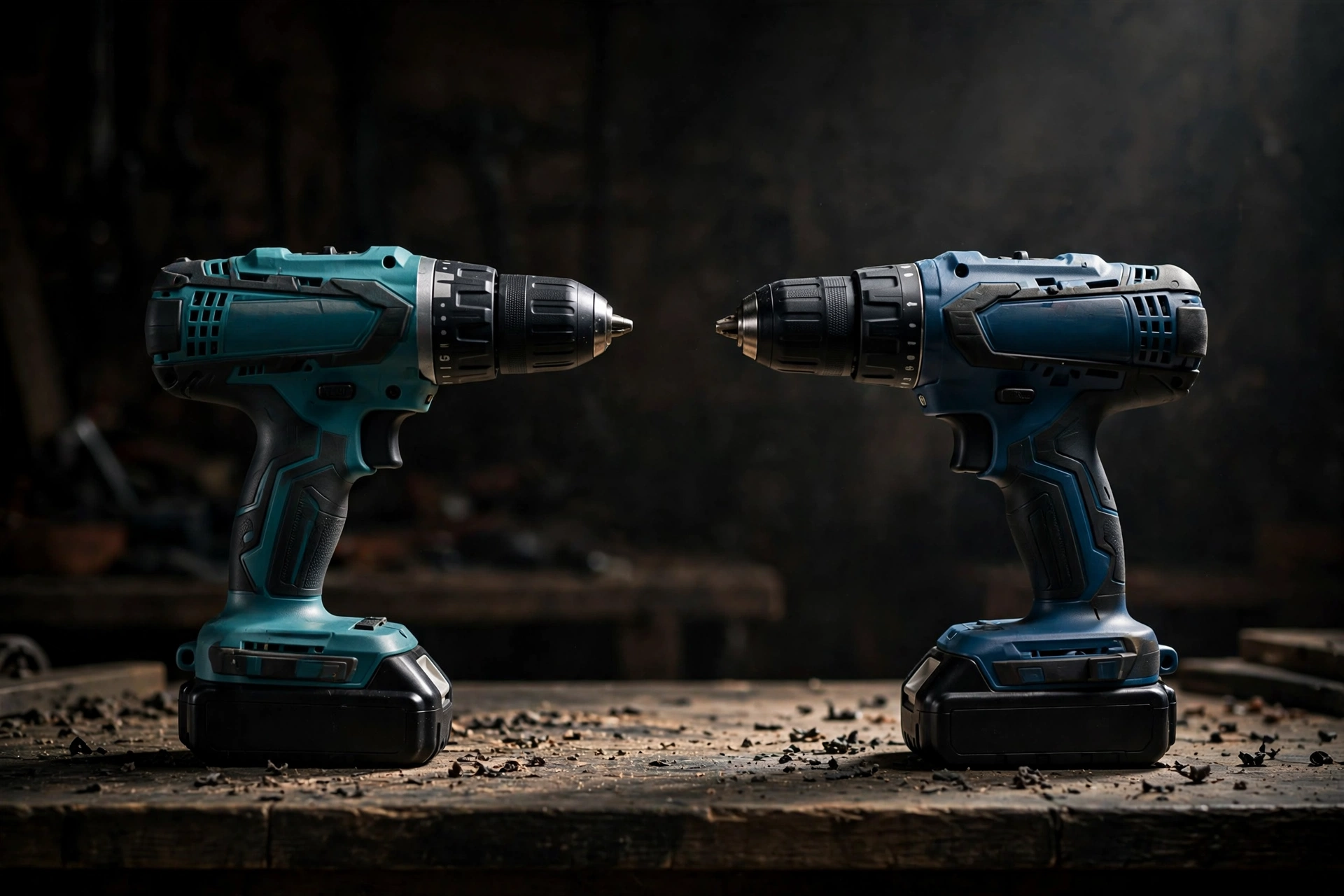
The fundamental truth: both make excellent tools — this is a choice between philosophies (breadth vs refinement, value vs innovation), not between quality and junk.
Battery platforms
Makita 18V LXT
- Breadth: 350+ tools (manufacturer spec — Makita’s official 2026 LXT count) — the largest 18V lineup in the world. If it can be cordless, Makita probably makes an 18V LXT version.
- 18V X2 (36V): two 18V batteries power 36V tools — clever system giving high power without a separate battery platform.
- 40V XGT: the newer high-power platform — growing rapidly, aimed at corded replacement.
- The strength: unmatched 18V breadth. Whatever you need, there’s an LXT tool for it.
Bosch 18V
- Breadth: solid but smaller than Makita’s — focused lineup covering the essentials well.
- ProCore18V batteries: excellent battery technology — the ProCore line (4Ah, 8Ah, 12Ah) offers superb power density.
- AMPShare: Bosch’s multi-brand battery alliance — one battery across Bosch and partner brands (an interesting ecosystem play).
- The strength: engineering refinement and battery tech, not sheer tool count.
Platform verdict: Makita for breadth (you’ll never lack a tool); Bosch for the battery tech and the AMPShare ecosystem bet.
Head-to-head: key tools
Drills and drivers
Both excellent. Makita’s 18V LXT drills are benchmarks for smoothness and refinement; Bosch’s are equally capable with superb ergonomics. Verdict: toss-up — Makita slight edge on lineup depth.
Circular saws
Makita’s 36V (18V X2) circular saws are outstanding — genuine corded replacements with excellent cut quality. Bosch’s 18V saws are good but the X2 power advantage shows. Verdict: Makita.
Angle grinders
Both superb — Makita’s grinders are jobsite legends (the corded ones especially); their 18V/36V cordless versions maintain the reputation. Bosch’s grinders are equally respected in metalworking. Verdict: toss-up.
Rotary hammers (SDS)
Bosch’s signature category — they invented the modern rotary hammer concept and their Bulldog line remains the benchmark. For concrete drilling, Bosch is the default professional choice. Verdict: Bosch, decisively.
Sanders
Makita’s sanders are superbly refined (low vibration, excellent dust collection); Bosch’s are equally good with innovative features. Verdict: toss-up — both excellent.
Routers
Makita’s compact routers (especially the 18V LXT trim router) are beloved — smooth, precise, the woodworker’s choice. Bosch’s routers (the Colt especially) practically defined the compact router category. Verdict: toss-up — try both.
Outdoor power equipment
Makita’s 36V/40V outdoor line is comprehensive and well-regarded. Bosch’s outdoor presence is smaller. Verdict: Makita.
Measuring and layout
Bosch’s other signature — laser measures, line lasers, and detection tools. Bosch leads this category industry-wide. Verdict: Bosch, decisively.
Innovation vs refinement
- Bosch innovates — they’re often first with new concepts (and the measuring/layout dominance proves it). The engineering-led approach produces clever solutions.
- Makita refines — they take existing concepts and execute them with Japanese precision: smoother, quieter, lower-vibration, better-balanced. The 18V LXT breadth reflects systematic, thorough platform building.
Neither philosophy is “better” — but they feel different in the hand. Makita tools often feel more refined; Bosch tools often feel more clever.
What they share
It’s easy to frame this as a rivalry, but the two brands overlap more than they differ: both are pro-grade (this comparison covers Bosch’s blue line only — the green DIY line is a different tier), both back their tools with 3-year warranties, both run deep brushless lineups, and both have global service networks. You’re choosing between philosophies, not between quality and junk — which is exactly why there’s no wrong answer here.
Price comparison
- Makita: competitive — often slightly less than DeWalt/Milwaukee equivalents, frequent sales, excellent value in kits.
- Bosch: comparable to Makita, sometimes slightly premium on innovative tools. The blue (professional) line is priced with the pro tier; the green (DIY) line is budget-friendly but a different quality tier — don’t confuse them.
The Bosch color trap: Bosch sells BLUE (professional) and GREEN (DIY) lines — different tools, different quality, different prices. This comparison is about Bosch BLUE. The green line competes with Ryobi, not Makita.
Keep This Chart Handy — Makita or Bosch for Your Situation
Find your row, read the why. Screenshot it if you’re standing in the tool aisle.
| You are… | Buy… | Why |
|---|---|---|
| Want the biggest 18V selection | Makita | 350+ LXT tools (2026 industry sources) — unmatched breadth |
| Concrete/masonry work | Bosch | Rotary hammer dominance |
| Measuring/layout priority | Bosch | Laser/detection leadership |
| Woodworking focus | Makita | Router, sander, and saw refinement |
| Value-conscious pro | Makita | Slight price edge, frequent sales |
| Innovation enthusiast | Bosch | Clever engineering, AMPShare ecosystem |
| General DIY | Either | Both exceed homeowner needs |
Quick verdicts by buyer type
Beginner: either brand is overkill in the best way — both will outlast your learning curve. Pick whichever starter kit is on sale and don’t look back.
Budget buyer: Makita — a slight price edge, frequent kit sales, and 350+ LXT tools means you’ll rarely pay a premium to stay in the system.
Pro: match the brand to the trade. Concrete, masonry, and layout work: Bosch Blue, decisively. Woodworking and general contracting: Makita’s breadth and refinement win.
Category by category: who actually wins where
If the sections above left you thinking both brands sound good at everything, this table is the tiebreaker. It is not about which logo is better overall — it is about which brand tends to win the specific tool you are buying next. Use it that way: find your row first, then decide whether that row matters enough to pick a whole platform around it.
| Category | Edge goes to | Why it matters in real use |
|---|---|---|
| Drills and impact drivers | Makita, narrowly | Both are excellent for everyday work. Makita tends to feel a touch smoother for long, repetitive fastening days, which is why many carpenters stay loyal to it. |
| Circular saws | Makita | A long-standing strength — smooth cutting and good sightlines matter more over a full day than a headline power figure on the box. |
| Rotary hammers and concrete | Bosch, clearly | This is Bosch Blue home turf. If you drill into concrete or masonry regularly, start your platform decision here, not with a drill kit. |
| Angle grinders | Too close to call | Pick on grip shape, switch style, and how the guard adjusts. Comfort and control beat brand loyalty for a tool you hold against resistance. |
| Sanders and routers | Makita | Woodworkers consistently value feel, dust handling, and smooth starts in this category — and that is where Makita has built its reputation. |
| Measuring, lasers, and detection | Bosch, clearly | If layout accuracy drives your work, Bosch gives you the deeper specialist range. Makita is fine for basics; Bosch treats measuring as a main event. |
| Outdoor and garden tools | Makita | The breadth of the LXT system shows up here. One battery family covering workshop and yard is a genuine convenience, not just a catalogue trick. |
| Future tool choice | Makita | With the larger 18V line-up already covered above, you are less likely to hit a gap later and need a second battery system. |
How to choose in ten minutes, without overthinking it
- List the next three tools, not just the first one. A drill kit is never the whole purchase. If those next three tools lean concrete and layout, lean Bosch. If they lean woodworking and outdoor, lean Makita.
- Hold both in the store if you can. Grip thickness, trigger feel, and balance with a battery fitted are personal. A tool that feels awkward in the aisle will feel worse on a ladder.
- Check what your local dealer actually stocks. Batteries, chargers, and service support nearby are worth more than a clever feature you will use twice a year.
- Ignore the green-versus-blue trap. As covered earlier, compare like with like. A low price on the DIY line is not a saving if you needed the professional line all along.
The mistake I see most often is buying the platform for the job you did once, not the work you do every week. A homeowner who drilled four holes in a garage wall last year does not need to choose Bosch for its concrete strength if the next five years are shelves, decking, and flat-pack furniture. Be honest about your real mix of work — roughly, not perfectly — and the table above will point you the right way almost every time.
Print This Before You Buy — The First-Kit Shopping Checklist
Take this list to the store and work through it before paying for a kit — it turns a brand debate into a buying decision.
- Confirm the Bosch box says Blue, not Green. The green DIY line competes with Ryobi, not with Makita’s 18V LXT professional platform.
- List the next three tools, not just the first drill kit. A drill kit is never the whole purchase, and the platform must cover what comes next.
- Match those three tools to the work done every week. Concrete and layout work lean Bosch; woodworking and outdoor work lean Makita.
- Hold both brands in the store with a battery fitted. Grip thickness, trigger feel, and balance are personal — a tool that feels awkward in the aisle feels worse on a ladder.
- Check what the local dealer actually stocks. Batteries, chargers, and service support nearby are worth more than a clever feature used twice a year.
- Weigh the ecosystem honestly. Makita offers 350+ LXT tools plus 18V X2 (36V) and 40V XGT for high power; Bosch offers ProCore18V batteries in 4Ah, 8Ah, and 12Ah plus the AMPShare multi-brand battery alliance.
- Treat warranty as a tiebreaker, not a decider. Both brands back their tools with solid 3-year warranties and good service reputations.
Common questions from undecided buyers
I already own one battery from the other brand — should I switch? One battery and a charger is a small sunk cost compared with a full kit. If your work clearly fits the other brand better, switching early is cheaper than building a large collection on the wrong platform and resenting it for years. If the fit is close, stay put and save the money.
Is it foolish to run two platforms? Not foolish, just inconvenient. Many pros quietly run a main platform plus one specialist tool from another brand. For most home users, though, one system means fewer chargers, shared batteries, and simpler storage — and that simplicity is worth real money over time.
Bookmark This Checklist — The 10-Minute Platform Test
Screenshot this before you buy. Every step comes from the choosing advice in this guide — work through it in order and the right platform picks itself.
- List your next THREE tools, not just the first one. A drill kit is never the whole purchase. If those next three lean concrete and layout, lean Bosch. If they lean woodworking and outdoor, lean Makita.
- Be honest about your real weekly work. The most common mistake is buying the platform for the job you did once, not the work you do every week. Drilling four holes in a garage wall last year does not make you a concrete contractor.
- Hold both brands in the store. Grip thickness, trigger feel, and balance with a battery fitted are personal. A tool that feels awkward in the aisle will feel worse on a ladder.
- Check what your local dealer actually stocks. Batteries, chargers, and service support nearby are worth more than a clever feature you will use twice a year.
- Ignore the green-versus-blue trap. This comparison is about Bosch BLUE (professional). The green DIY line competes with Ryobi, not Makita — a low price on the DIY line is not a saving if you needed the professional line all along.
- Weigh the ecosystem honestly. Makita: 350+ LXT tools and 18V X2 (36V) plus 40V XGT for high power. Bosch: ProCore18V batteries (4Ah, 8Ah, 12Ah) and the AMPShare multi-brand battery alliance — an interesting bet, but newer and smaller than LXT, so treat it as a tiebreaker, not a decider.
- Count the sunk cost, then let it go. One battery and a charger from the other brand is a small sunk cost. If your work clearly fits the other brand better, switching early is cheaper than building a large collection on the wrong platform and resenting it for years. If the fit is close, stay put and save the money.
Bookmark This Checklist — 6 Platform Mistakes to Avoid
Screenshot this before you buy — every mistake below is one this guide warns about, and each one costs real money or real regret.
- Buying for the job you did once. Drilling four holes in a garage wall last year does not make you a concrete contractor — buy for the work you do every week, not the job you did once.
- Falling for the green-versus-blue trap. Bosch Green is the DIY line — it competes with Ryobi, not with Makita’s 18V LXT professional platform. Compare blue to teal, like with like, or a low price on the DIY line is no saving at all.
- Buying only the first drill kit. A drill kit is never the whole purchase. List your next three tools before you commit — the platform has to cover what comes next, not just what is in the box.
- Never holding the tools. Grip thickness, trigger feel, and balance with a battery fitted are personal. A tool that feels awkward in the aisle will feel worse on a ladder.
- Ignoring what your local dealer stocks. Batteries, chargers, and service support nearby are worth more than a clever feature you will use twice a year.
- Letting one battery decide for you. One battery and a charger is a small sunk cost compared with a full kit. If your work clearly fits the other brand better, switching early is cheaper than building a large collection on the wrong platform and resenting it for years.
Is Makita better than Bosch?
Neither — they’re peers with different strengths. Makita: breadth and refinement. Bosch: concrete tools, measuring, and innovation. The “better” brand is the one whose strengths match your work.
What’s the difference between Bosch blue and green?
Blue = professional line (this comparison). Green = DIY line (lighter duty, lower price, competes with Ryobi/Black+Decker). They’re essentially different brands sharing a name — never compare green Bosch to Makita LXT.
Should I choose Makita over DeWalt/Milwaukee?
Makita’s 18V LXT breadth rivals anyone’s, and their refinement is real — many professionals prefer Makita’s feel. The DeWalt vs Milwaukee guide covers that rivalry; Makita belongs in the same conversation, not a tier below.
Is Bosch’s AMPShare system worth considering?
It’s an interesting bet — one battery across multiple brands. If the partner brands make tools you want, it’s compelling. But it’s newer and smaller than Makita’s LXT ecosystem. Consider it a tiebreaker, not a decider.
Which brand is better for woodworking?
Makita, slightly — their routers, sanders, and saws have a refinement woodworkers appreciate, and the LXT breadth covers every woodworking need. Bosch is perfectly capable; Makita just feels more at home in the woodshop.
Do Makita and Bosch honor warranties well?
Yes — both have solid 3-year warranties and good service reputations. Neither matches Milwaukee’s 5-year terms, but both are reliable. Warranty shouldn’t decide between these two.
The verdict
Makita for breadth and refinement; Bosch for concrete, measuring, and engineering innovation.
- The woodworker who wants every tool in one battery system → Makita LXT.
- The contractor who lives in concrete and layout → Bosch Blue.
- Everyone else → hold both, pick the feel, commit to the platform.
If neither fits: the two biggest pro ecosystems in North America are DeWalt 20V Max and Milwaukee M18 — our DeWalt vs Milwaukee impact driver comparison and battery platform showdown cover that rivalry. Buying strictly for home DIY? Read Milwaukee vs Ryobi for DIY before spending pro money.
Like the DeWalt/Milwaukee debate, this one has no wrong answer — just a better fit. And frankly, the fact that you’re choosing between Makita and Bosch (rather than buying the cheapest no-name kit) means you’ve already made the important decision: buying quality once instead of junk twice.
Tool Worth Lab provides research-based comparison guidance. This comparison covers Bosch’s professional (blue) line vs Makita’s 18V LXT/40V XGT platforms — general 2026 assessments; specific models vary. Prices are approximate US street prices.
Keep Reading
Loved this guide? These related articles will keep your project moving: