
Quick Answer: An angle grinder is the bigger tool — it cuts and grinds metal, tile and masonry with discs. A die grinder is a compact precision tool that spins small bits at 25,000+ RPM for deburring, polishing and detail work. They share a name, but they own completely different jobs — and buying the wrong one is an expensive lesson.
Two tools, one word in the name, and a price tag that punishes the wrong guess. Pick the angle grinder for detail work and you will fight it all afternoon; pick the die grinder to cut steel plate and you will still be there at dinner, surrounded by a pile of dead bits. I have watched people make both mistakes, and both end the same way: money spent, job unfinished, and a tool gathering dust in the corner.
Here is the thing that trips everyone up: these two tools look like cousins, but they are built for opposite jobs. One is a two-handed beast that tears through steel plate with 4-1/2 in (115 mm) discs at 11,000 RPM. The other is a pencil-slim precision tool that spins tiny bits at 25,000+ RPM to sneak into corners your fingers barely fit. Same family, completely different personalities — and the shop that owns both is a shop that can do almost anything.
By the end of this guide you will know exactly which one deserves your money first, the rare jobs where one can cover for the other, and the one safety rule that matters more on these tools than on almost anything else in your shop. If you can only buy one, the answer is clear — but it might not be the one you expect.
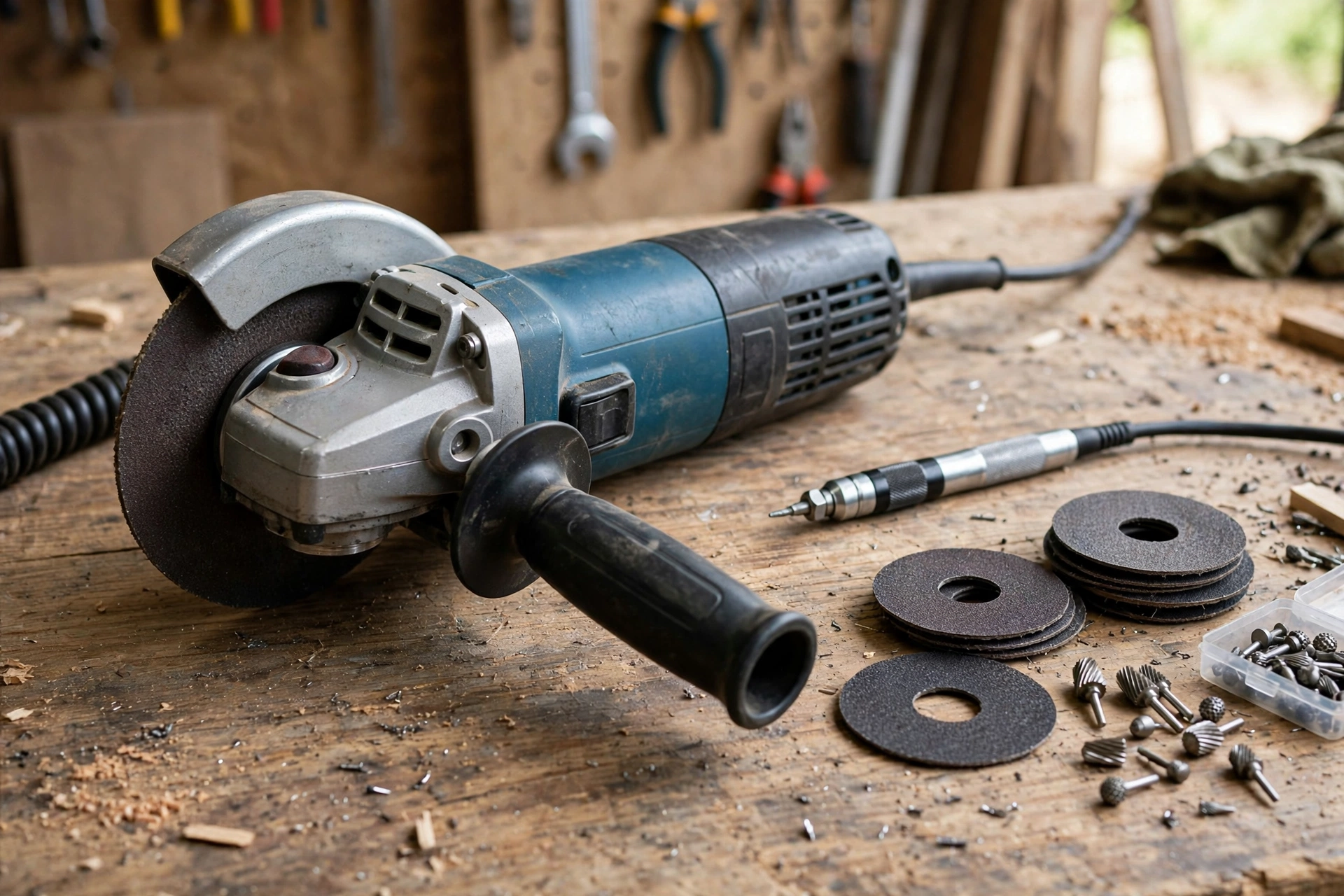
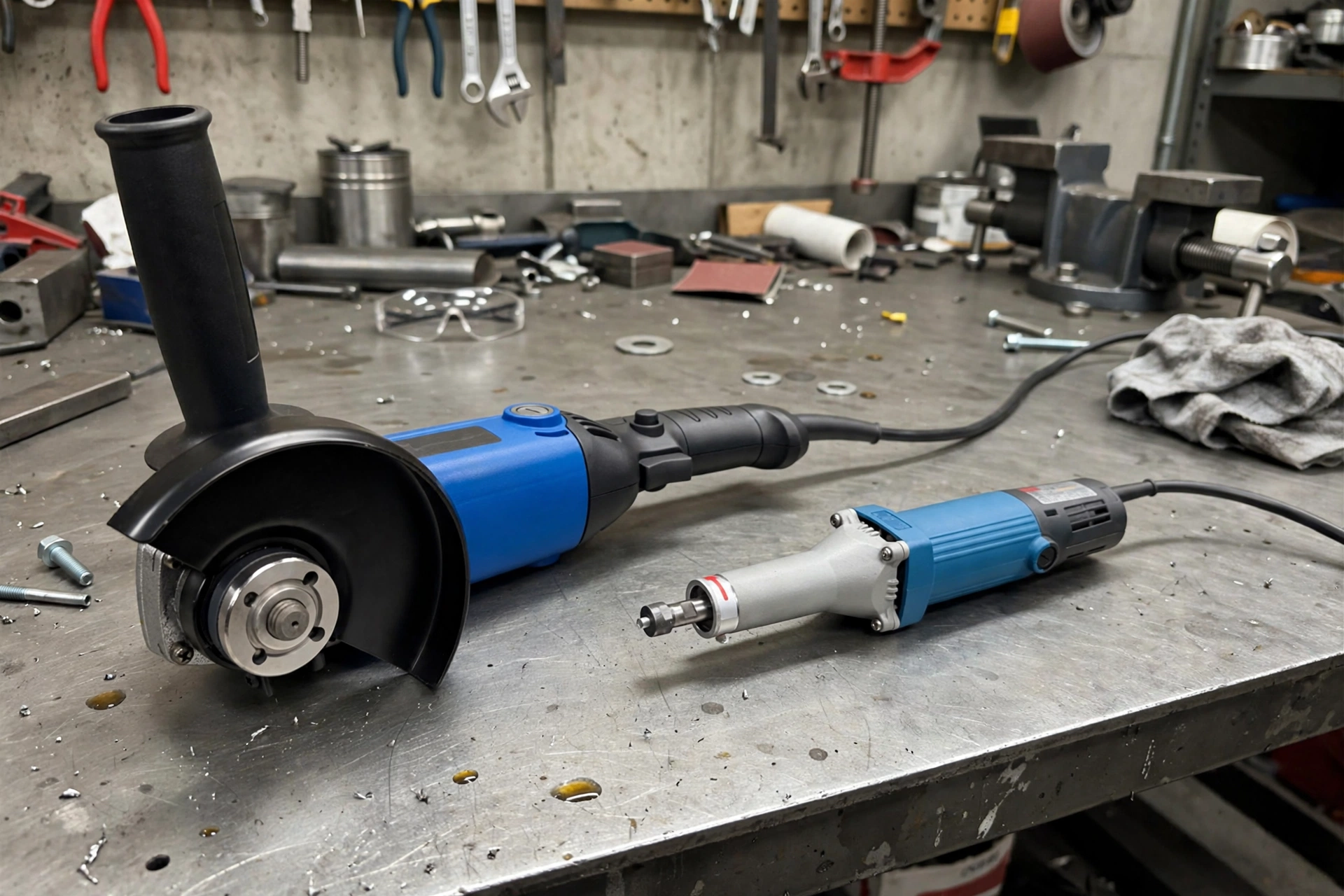
Safety first: Both tools demand respect. Angle grinders are among the most dangerous handheld power tools — always use the guard, wear eye protection and gloves, and never use a cutting disc for grinding (or vice versa). Die grinders spin tiny bits at 25,000+ RPM — eye protection is non-negotiable, and a shattered bit at that speed is no joke.
What they share
For all their differences, these two come from the same family — and they share more than the word “grinder”:
- Both spin abrasives, not blades. Grinding discs, wire wheels, burrs and stones — the cutting happens through abrasion, which is why both throw debris and both demand eye protection.
- Both punish sloppy technique the same way. Binding, kickback and shattered accessories are the classic injuries for both tools. The safety habits that protect you on an angle grinder — guard on, two firm hands or a controlled grip, letting the tool do the work — transfer directly. (Our angle grinder safety guide covers the full checklist.)
- Both reward the right accessory. A cutting disc is not a grinding disc, and a carbide burr is not a grinding stone. On both tools, most “bad results” are just the wrong accessory for the job.
- Both come in corded and cordless flavors (die grinders also come pneumatic) — and on both, corded wins for long sessions while cordless wins for quick jobs.
- Both are metalworking staples. In a small shop, the angle grinder roughs things out and the die grinder finishes them. They’re teammates, not rivals.
Quick answer
Angle grinder: the big, aggressive one. 4-1/2″ to 9″ discs, 11,000 RPM, built for cutting metal, grinding welds, and removing serious material fast. Think demolition and fabrication.
Die grinder: the small, precise one. 1/4″ collet holding tiny bits and burrs, 25,000+ RPM, built for detail work — deburring, porting, engraving, grinding in tight spots. Think surgery, not demolition.
Buy the angle grinder if: you cut metal, grind welds, cut tile/concrete, or do any heavy material removal.
Buy the die grinder if: you do detail metalwork, deburring, mold work, porting, or need to grind where an angle grinder physically can’t reach.
They don’t really compete — they complement. But if you can only buy one, the angle grinder is vastly more versatile for general use.
Size and form factor: the obvious difference
An angle grinder is a two-handed tool (or should be — always use the side handle). A typical 4-1/2″ model is about 12 inches long and weighs 4–6 pounds. You hold it like a weapon because, frankly, that’s the energy it brings.
A die grinder is a one-handed tool — long, slim, pencil-like. Most are 6–8 inches long and weigh 1–2 pounds (pneumatic) or a bit more (electric). You hold it like a fat pen, guiding it with fingertip control.
This size difference is the use-case difference. The angle grinder’s mass and power suit aggressive work on large pieces. The die grinder’s lightness suits controlled work on small features.
Power and speed: different philosophies
| Angle grinder (4-1/2″) | Die grinder (electric) | |
|---|---|---|
| Typical power | 7–15 amps (800–1,700W) | 3–5 amps (350–600W) |
| Speed | ~11,000 RPM | 25,000–30,000 RPM |
| Accessory size | 4-1/2″–9″ discs | 1/4″ shank bits, 1–2″ burrs/wheels |
| Material removal | Very fast | Slow, controlled |
| Precision | Low — it’s a blunt instrument | High — fingertip control |
Notice the paradox: the die grinder spins faster but removes less material. Speed isn’t power — the die grinder’s tiny bits at 25,000 RPM are about finesse, not force. The angle grinder’s big disc at 11,000 RPM carries enormously more cutting energy per revolution.
What each tool actually does
Angle grinder jobs
- Cutting metal: rebar, angle iron, bolts, sheet metal (with cutting discs)
- Grinding welds: flattening and smoothing weld beads (with grinding discs)
- Cutting tile, stone, concrete: with diamond blades
- Rust and paint removal: with wire wheels
- Sharpening: lawnmower blades, axes, mower blades (with grinding discs)
- Notching and shaping metal stock
If you’re doing fabrication, auto body rough work, or any construction-adjacent task, the angle grinder is indispensable. It’s one of the first tools a metalworker buys, for good reason.
Die grinder jobs
- Deburring: cleaning sharp edges off machined or cut metal
- Porting and polishing: engine porting, mold polishing
- Engraving and carving: metal, stone, wood detail work
- Grinding in tight spots: inside tubes, narrow channels, intricate shapes
- Weld cleanup in tight areas: where a 4-1/2″ disc can’t fit
- Rotary carving: with carbide burrs on wood
If the angle grinder is a broadsword, the die grinder is a scalpel. Metalworkers, welders doing finish work, and anyone doing detail fabrication will reach for it constantly.
Can one substitute for the other?
Can a die grinder replace an angle grinder? For all practical purposes, no. A die grinder cutting through 1/4″ steel plate would take approximately forever and burn through a pile of bits. It physically cannot do what an angle grinder does — the power and disc size aren’t there.
Can an angle grinder replace a die grinder? Sometimes, barely. With a small flap disc or a wire wheel, an angle grinder can do rough deburring. But for anything requiring precision — porting, engraving, tight spots — it’s like performing surgery with a chainsaw. Technically a cutting tool. Practically a disaster.
The honest answer: they’re different tools for different jobs. The question isn’t really “which one” — it’s “which one first.”
Pneumatic vs electric die grinders
Worth a quick note since it confuses buyers: die grinders come in pneumatic (air-powered) and electric versions.
- Pneumatic: lighter, smaller, cheaper ($30–$80), but needs an air compressor capable of ~4–6 CFM at 90 PSI continuously. If you already have a serious compressor, pneumatic die grinders are fantastic value.
- Electric: heavier and pricier ($80–$200), but no compressor needed. Better for people without shop air.
If you don’t own a compressor, don’t buy a pneumatic die grinder as an excuse to buy a compressor. Buy electric.
Before You Buy: Answer These 5 Questions — Print This Before You Buy
Do not start with brands or prices. Start with these five questions — your answers pick the tool for you, and they take about a minute.
- Big cutting and grinding, or tiny detail work? Cutting metal, grinding welds, or cutting tile and concrete points to the angle grinder. Deburring, porting, engraving, or grinding in tight spots points to the die grinder.
- Do you already own a serious compressor? A pneumatic die grinder needs an air compressor capable of about 4–6 CFM at 90 PSI continuously. No compressor? Buy electric — do not buy a pneumatic die grinder as an excuse to buy a compressor.
- Long sessions or quick jobs? On both tools, corded wins for long sessions while cordless wins for quick jobs — and corded angle grinders are the pick for extended grinding, since batteries drain fast under continuous load.
- Only buying one tool for general DIY? Buy the angle grinder first, specifically a 4-1/2″ model — it is vastly more versatile for general use.
- Is your work light-duty crafts only? Small engraving, hobby carving, or polishing jewelry may need neither tool — a rotary tool does die-grinder-style detail work at a gentler pace and costs far less. Just know its limit: it is a toy next to a die grinder for real metalwork, so buy the real thing once your projects outgrow crafts.
Shortcut: if you already own an angle grinder and keep thinking “I wish I could get in there” — that is the die grinder calling. Answer it.
Your First Accessory Kit — Keep This Chart Handy
On both grinders, most bad results are just the wrong accessory for the job. Buy these first and the tool does what it is supposed to do.
| Tool | Buy first | What it does |
|---|---|---|
| Angle grinder (4-1/2 in / 115 mm to 9 in / 230 mm discs) | Cutting disc | Cuts metal: rebar, angle iron, bolts, and sheet metal. |
| Angle grinder | Grinding disc | Flattens and smooths weld beads, and sharpens lawnmower blades and axes. Never use a cutting disc for grinding, or a grinding disc for cutting. |
| Angle grinder | Diamond blade | Cuts tile, stone, and concrete. |
| Angle grinder | Wire wheel | Removes rust and paint. |
| Die grinder (1/4 in / 6.35 mm collet, 1–2 in / 25–51 mm burrs and wheels) | Basic carbide burr set | The starter set for die grinder work: deburring sharp edges, porting, engraving, carving, and grinding in tight spots a 4-1/2 in / 115 mm disc cannot reach. |
| Die grinder | Grinding stones | Detail grinding and shaping in tight areas, including weld cleanup where a large disc cannot fit. |
Which should you buy first?
For 90% of buyers, the answer is the angle grinder — specifically a 4-1/2″ model. It’s one of the most versatile power tools ever made: it cuts, grinds, sands, polishes, and sharpens across metal, masonry, and tile. Every DIYer doing anything beyond woodwork eventually needs one.
Buy the die grinder first only if your work is specifically detail metalwork — you’re already doing fabrication and keep hitting spots the angle grinder can’t reach, or you’re getting into porting/engraving.
And if you already own the angle grinder and keep thinking “I wish I could get in there” — that’s the die grinder calling. Answer it.
Neither fits? The third option: a rotary tool
If your work is light-duty — crafts, small engraving, hobby carving, polishing jewelry — you may not need either of these. A rotary tool (the Dremel-style kind) does die-grinder-style detail work at a gentler pace, costs far less, and won’t intimidate a beginner.
The one-line verdict: a rotary tool covers detail work for hobbyists, but it’s a toy next to a die grinder for real metalwork — buy the real thing once your projects outgrow crafts.
Keep This Chart Handy — Angle Grinder vs Die Grinder at a Glance
One chart, every difference that matters. Screenshot this before you buy.
| Angle grinder | Die grinder | |
| Typical size | About 12 in (30 cm) long | 6–8 in (15–20 cm) long, pencil-slim |
| Weight | 4–6 lb (1.8–2.7 kg) | 1–2 lb (0.5–0.9 kg) pneumatic; a bit more electric |
| Grip | Two-handed — always use the side handle | One-handed, like a fat pen, fingertip control |
| Typical power | 7–15 amps (800–1,700 W) | 3–5 amps (350–600 W) electric |
| Speed | ~11,000 RPM | 25,000–30,000 RPM |
| Accessory | 4-1/2 in–9 in (115–230 mm) discs | 1/4 in (6 mm) shank bits, 1–2 in (25–50 mm) burrs and wheels |
| Material removal | Very fast | Slow, controlled |
| Precision | Low — a blunt instrument | High — fingertip control |
| Best for | Cutting metal, grinding welds, tile and masonry | Deburring, polishing, detail work, tight spots |
| Power source | Electric, corded or cordless | Pneumatic (needs ~4–6 CFM at 90 PSI) or electric |
Is a die grinder the same as a Dremel?
Same concept (small rotary tool, high RPM), different league. A Dremel is a light-duty rotary tool for crafts and hobby work. A die grinder is the industrial version — more power, 1/4″ collet (vs Dremel’s 1/8″), built for metalwork. A Dremel can’t do what a die grinder does, though a die grinder can do most Dremel jobs.
Can I use angle grinder discs on a die grinder?
No — completely different mounting. Angle grinder discs mount on a threaded arbor; die grinder bits use a 1/4″ collet. They’re not interchangeable in either direction.
What bits do I need for a die grinder?
Start with a basic carbide burr set (cylinder, ball, tree, and flame shapes cover most work), plus a few mounted grinding stones and maybe a wire brush. Buy decent burrs — cheap ones dull fast and chatter.
Is an angle grinder dangerous for beginners?
It’s the power tool that deserves the most respect in a beginner’s hands. Always use the guard and side handle, never grind with a cutting disc, let the tool do the work (don’t force it), and be aware of where sparks are going. Know what your grinder is telling you — unusual sparking or overheating means stop and investigate.
Corded or cordless for these tools?
Angle grinders: corded for extended grinding sessions (batteries drain fast under continuous load); cordless is fine for quick cuts. Die grinders: electric corded or pneumatic — cordless die grinders exist but are niche. Full corded vs cordless breakdown here.
Can a die grinder cut metal?
Thin sheet metal and small stock, yes — with cutoff wheels made for die grinders. Anything structural or thick: use the angle grinder. Right tool, right job.
The 60-Second Safety Check Before You Switch On — Bookmark This Checklist
Both of these tools demand respect, and the angle grinder is among the most dangerous handheld power tools you can own. Run this check every single time before the switch goes on — it takes a minute and it is the difference between a good day in the shop and a trip to the emergency room. Screenshot this for the shop.
| Check | Why it matters | What happens if you skip it |
|---|---|---|
| Guard on, side handle on (angle grinder) | Angle grinders are among the most dangerous handheld power tools — the guard is your only shield | A shattered disc at 11,000 RPM with no guard is a severe-injury accident, not a close call |
| Right disc for the job — cutting disc for cutting, grinding disc for grinding | A cutting disc is not a grinding disc, and most bad results are just the wrong accessory for the job | Never grind with a cutting disc — cutting discs shatter sideways when used for grinding |
| Ring-test the disc before mounting it | A cracked disc must never spin up | Tap the disc — a cracked disc sounds dead, not musical. A dead-sounding disc goes in the bin, not on the tool. |
| Eye protection on — and gloves on (die grinder: eye protection is non-negotiable) | Both tools throw debris, and die grinder bits spin at 25,000+ RPM | A shattered bit at 25,000+ RPM is no joke — eye protection is the cheapest insurance in the shop |
| Correct accessory seated properly — 4-1/2 in (115 mm) discs on the angle grinder, 1/4 in (6.35 mm) shank bits in the die grinder collet | Angle grinder discs mount on a threaded arbor; die grinder bits use a 1/4 in collet — they are not interchangeable in either direction | A wrongly mounted accessory binds, kicks back, or shatters — binding, kickback and shattered accessories are the classic injuries for both tools |
| Two firm hands (or a controlled grip), and let the tool do the work | Forcing the tool causes binding and kickback | Pushing too hard is how discs bind and shatter — the tool’s weight and speed do the cutting, not your arms |
Pro tip: if anything feels wrong — unusual sparking, overheating, or a strange vibration — stop and investigate before the next cut. Your grinder talks in sparks; learn to listen.
The verdict
| Your situation | Buy this |
|---|---|
| First metalworking tool | Angle grinder (4-1/2″) — most versatile |
| Cutting/grinding metal, welds, tile | Angle grinder — it’s what it’s for |
| Detail work, deburring, tight spots | Die grinder — precision the angle grinder can’t match |
| Engine porting, mold work | Die grinder — its home turf |
| Only buying one, general DIY | Angle grinder — no contest on versatility |
| Already own an angle grinder, need finesse | Die grinder — the perfect complement |
Different names, different tools, different jobs. The angle grinder is the muscle — buy it first. The die grinder is the finesse — buy it when your work gets precise enough to need it. Together, they cover essentially all rotary metalwork a DIYer or small shop will ever face.
Keep Reading
Angle Grinder Safety Guide: The Rules That Keep All Ten Fingers
Angle grinders are the power tool that deserves the most respect — here’s the full safety checklist before your first cut.
Why Your Angle Grinder Disc Keeps Breaking
Shattered discs are terrifying and almost always preventable — the causes, ranked by likelihood.
Angle Grinder Sparks Too Much? What It’s Telling You
Your grinder talks in sparks — learn to read what normal looks like versus what means stop.
Tool Worth Lab provides research-based buying guidance. Both tools demand full safety gear — eye protection, gloves, and hearing protection. Never operate an angle grinder without its guard.